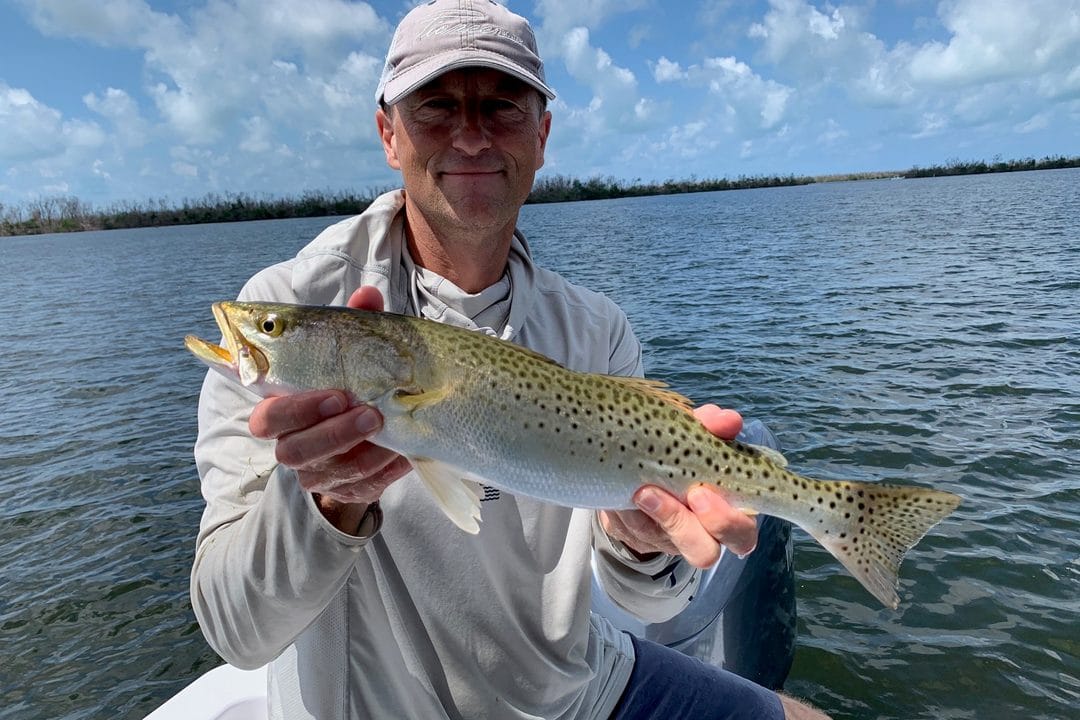
The first blowup comes about six minutes after the boat goes quiet — a slashing strike on a walking bait that sounds louder than it should in the flat morning calm, followed by three or four more fish working a grass edge before the sun even clears the tree line. By eight o'clock, sometimes earlier, it stops cold. Not tapers off — stops, as if someone flipped a switch on the whole flat. Anglers who don't understand why spend the rest of the morning beating water that no longer holds fish, while the ones who do simply follow the trout to where they went. Most of them end up thirty or forty yards away, working a completely different piece of structure than the one that produced at first light. It's a short move on the chart and a completely different mindset on the water, and the anglers who make it consistently outfish the ones anchored to whatever spot worked yesterday.
Why the Bite Dies the Moment the Sun Clears the Trees
Spotted seatrout — speckled trout to most people who fish for them from Texas to the Carolinas — don't tolerate heat the way redfish do. A shallow grass flat on the Gulf Coast can run 78–80°F at first light in July and climb past 88°F by mid-morning once direct sun hits water that's barely eighteen inches deep. Redfish will sit in that warming water and keep feeding, tailing right through the heat. Trout won't. Their gills can't handle the drop in dissolved oxygen that comes with warm, still water nearly as well, so as the flat heats up, the fish that were blowing up on topwater at dawn slide off the grass and stack somewhere cooler — a channel edge, a pothole, a dock with current running under it. This is the single biggest mistake anglers make chasing seatrout in summer: treating the flat like a redfish flat and staying on it two hours past when the trout have already left.
The Dawn Topwater Window — Forty Minutes, Not Four Hours
Set realistic expectations for how long this actually lasts. In most Gulf Coast and mid-Atlantic grass systems, the topwater window on a stable-weather July morning runs from roughly first light to about forty-five minutes after true sunrise — sometimes less if there's already a west wind pushing chop across the flat. A walk-the-dog bait beats a popping-style plug in that window, hands down; the side-to-side action mimics a fleeing baitfish better than surface commotion does, and trout committed to ambushing something wounded respond to that motion more consistently than to noise alone. A MirrOlure Top Dog Jr or a Heddon Super Spook Jr, both in the $14–19 range, cover this window well in a bone or chrome/black pattern that reads against low light.
Don't slow the retrieve down to "match the mood" the way you might with bass. Keep the cadence tight and rhythmic — walk, walk, walk, pause for a two-count, repeat — and resist the urge to speed up after a blowup that misses the hooks. Trout that miss a topwater strike will often eat the same bait again within the next two or three casts if you hold your nerve and keep the retrieve exactly the same.
The single cast that tells you the window just closed
You'll feel it before you see it: a follow with no commitment, a half-hearted swirl instead of a full strike, then nothing. That's the flat telling you the fish have already started sliding toward deeper water.
Reading Deep Grass Edges and Potholes Once the Sun Climbs
Once that window closes, the pattern shifts entirely, and this is where most weekend anglers give up and go home instead of catching their best fish of the day. Look for the drop where grass on a 2-foot flat falls off into 4 to 6 feet of water along a channel edge, or for sandy potholes scattered through thicker grass — open, current-swept holes about the size of a truck bed that stay a few degrees cooler than the surrounding vegetation. Seatrout stack on these edges through the heat of the day, sitting just off the drop where they can dart up to ambush bait moving along the grass line without exposing themselves to full sun. A trolling motor with spot-lock and a basic temperature gauge on the graph turn this from guesswork into something closer to reading a map; drop a Spot-Lock waypoint on any pothole that reads 2–3 degrees cooler than the flat around it and work it hard before moving on.
Fan-cast the edge itself rather than the middle of the pothole — trout hold tight to the transition line between grass and sand, not out in open water where there's no ambush cover, and a bait dragged across bare sand three feet from that line will get ignored while one worked right along the edge gets crushed. Three or four casts covering the full arc of one edge, then move to the next pothole, beats parking on a single spot and hoping the school is still there twenty minutes later.
Live Bait Under a Popping Cork — Rig Notes
Once the sun is high, live bait under a popping cork out-produces artificials on most of these deep grass edges, and there's no real argument against switching over once the topwater window has closed. The standard rig: a Cajun Thunder or Four Horsemen popping cork ($6–8), 18–24 inches of 20-pound fluorocarbon leader below it, and a 1/0 to 2/0 Owner Mutu Light circle hook. Live shrimp under a hard chin-hook works everywhere; a finger mullet or small pinfish tends to draw the bigger fish on the same grass edges, particularly by late July when trout start keying more on baitfish than on shrimp.
- Pop the cork hard enough to make real noise, not a gentle tick — trout key on the commotion from a genuine distance across a grass flat
- Pause five full seconds after each pop before popping again; most strikes come in that pause, not during the pop itself
- Watch the cork, not the rod tip — a trout eating a live bait under a cork often just pulls it under without any dramatic strike
- Re-hook bait that's been mangled by a short strike rather than fishing it dead-looking through the next several casts, and so on
Skip the wire leader entirely for seatrout — their mouths are soft and toothless compared to Spanish mackerel or bluefish, and 20-pound fluorocarbon is both stealthier in clear grass-flat water and plenty strong enough to handle anything short of a genuinely oversized "gator" trout. Wire only earns its place back in the box if mackerel or a rogue bluefish start cutting off rigs on the same edge, which happens often enough in high summer that it's worth carrying a few pre-tied anyway.
The Weather Variable That Wrecks the Whole Pattern
Every bit of this pattern falls apart the moment a July afternoon thunderstorm rolls through, and Gulf Coast anglers know that better than anyone.
The barometric pressure crash that comes ahead of a summer storm shuts seatrout down almost completely, sometimes for several hours after the storm itself has passed and the sky has cleared. Fish that were stacked tight on a pothole edge at eleven in the morning can vanish by early afternoon, not because they moved somewhere else on the flat but because they've simply stopped feeding until pressure stabilizes. Chasing them harder in that window rarely works — the smarter move is switching to a different stretch of water entirely, working a deeper channel or a dock line where residual current keeps some oxygen moving, or simply waiting the front out rather than burning bait and gas on fish that have shut their mouths for the afternoon.
Tide Timing Beats Time of Day More Often Than Anglers Admit
Plenty of anglers plan a summer trout trip entirely around sunrise and never check the tide chart, and that's backwards. A dead slack tide at dawn — no current moving either direction — can kill the topwater bite outright even with perfect light and calm water, because seatrout feed by ambush and need moving water to push bait past a grass edge or a pothole mouth. The better mornings pair first light with either the last two hours of an incoming tide or the first two hours of an outgoing one, when there's enough current to stack bait against structure without making the water too fast to fish. Check the tide chart for the pass or inlet nearest the flat the night before, not the morning of, and build the trip around whichever dawn window actually has moving water instead of defaulting to whatever time looks good on paper.
Outgoing tide tends to be the stronger of the two on most Gulf grass systems in summer, since it pulls bait and shrimp off the flat and concentrates them at the mouths of potholes and along channel edges — exactly the ambush points already covered above. An incoming tide can still produce, especially once it starts flooding fresh grass with slightly cooler water from deeper channels, but it rewards patience more than the outgoing stage does. A falling tide paired with that dawn topwater window is close to the best two hours most inshore anglers will get on a grass flat all July, and it's worth rearranging a weekend around when the two actually line up.
Handling Trout in July Heat — the Release Actually Matters
Spotted seatrout are considerably more fragile than redfish once they're out of the water, and summer heat makes that worse. Their scales come off easily against a rough deck, and a fish held out of the water for even thirty seconds on a 95°F afternoon is under real stress before it ever goes back over the side. Measure quickly against a ruler decal stuck to the gunwale rather than pulling the fish fully onto a hot non-skid deck, keep hands wet, and support the belly rather than gripping through the gills the way you might with a bass. A trout that swims down hard on release recovered fine; one that floats on its side for more than a few seconds needs a minute of forward motion through the water, gently, to push oxygen back across the gills before you let go for good.
That last detail sounds like a small thing until you've watched a good pothole go quiet for the rest of the afternoon after a few fish were handled carelessly and released half-stunned near the same spot the school was holding — trout that don't recover well tend to spook everything nearby on the way down, and a school that scatters off a pothole in July heat often doesn't come back to that exact spot before the next tide change. Treat the release with the same seriousness as the cast, especially on a pattern this location-dependent, because the whole point of finding a productive pothole is being able to fish it again in an hour once the bite windows shift with the tide.