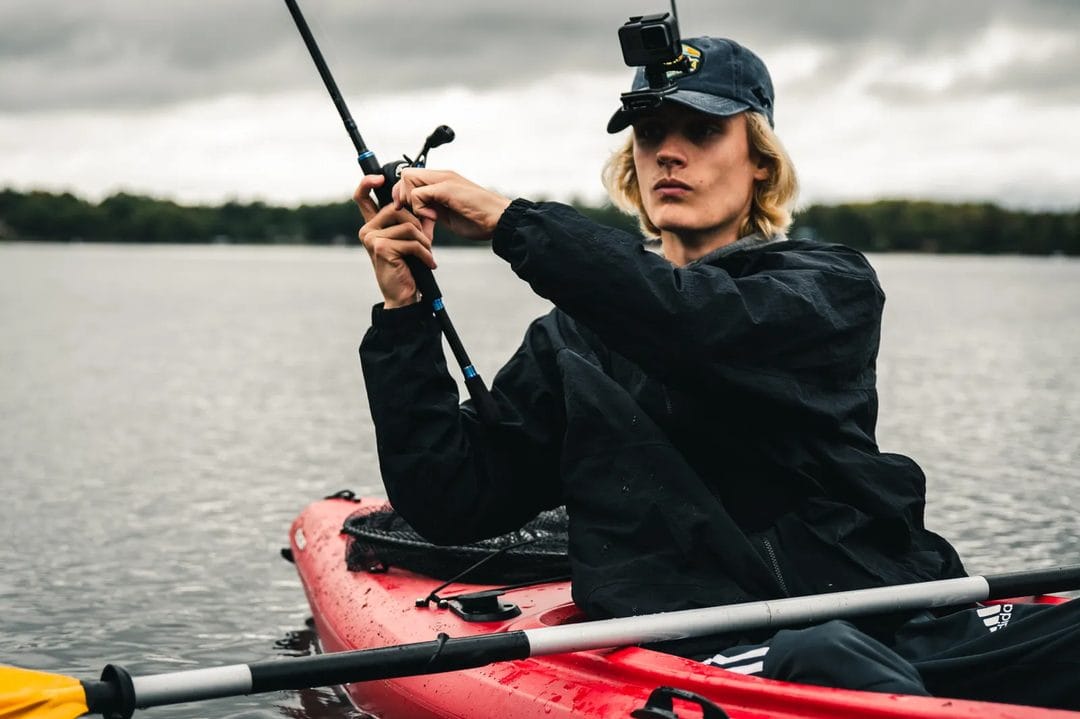
The first tailing redfish most kayak anglers ever see isn't actually seen — it's heard. A faint push of water, almost a sigh, coming off a flat that looks otherwise dead calm under the July sun. By the time the angler's eyes catch up to the sound, the fish has usually already caught the paddle stroke, felt the pressure wave through six inches of water, and put itself two hundred yards away in the mangroves. Skinny water redfish don't give second chances the way deeper, murkier water does, and that single fact separates the anglers who fill a summer with memorable days from the ones who spend the season chasing wakes.
Why skinny flats punish everything a boat does well
A bay boat with a poling platform and a trolling motor set on 3 mph feels stealthy from the deck. On a flat holding two feet of water or less, it isn't. The hull displacement alone pushes a pressure wave ahead of the boat that redfish detect through their lateral line long before any visual contact, and on the hottest, clearest days of July and August — exactly when fish push onto skinny grass flats to feed on fiddler crabs and mud minnows — that pressure sensitivity is at its sharpest. A kayak sits lower, displaces less water, and, critically, makes no motor hum at all when paddled correctly. That's the entire argument for fishing skinny water from a kayak rather than a technical poling skiff: not romance, not minimalism for its own sake, but a genuine reduction in the signals that push fish off the flat before a cast is even possible.
None of that advantage survives careless handling, though. A kayak paddled aggressively, with the blade slapping the surface on the recovery stroke, spooks fish just as effectively as an outboard idling past — sometimes worse, because the angler is closer when it happens. Redfish on skinny flats have usually been pushed by ospreys, dolphins, and other anglers all summer, and by late July the survivors in any given flat are the wariest fish left in the population. Assume every fish still tailing in six inches of water in August earned that caution the hard way.
Reading the flat before a single fish shows itself
Tails and wakes get the photos, but they're the least reliable sign on a summer flat — by the time a fish tails, it's often already committed to feeding and briefly less alert, which is useful, but plenty of good fish never break the surface at all. Better indicators come earlier. Mud clouds the colour of weak tea, drifting with no wind to explain them, mark a fish rooting for crabs in the grass. Nervous water — a patch of surface that looks subtly disturbed against the glass-calm water around it, without an obvious wake — usually means a school moving with intent rather than a single cruising fish. Mullet behaviour matters too: a pod of mullet that suddenly bunches tight and stops feeding is reacting to something, and on a redfish flat that something is worth a long look through polarised lenses before assuming it's just a shark passing through.
Wind direction on the day changes almost everything about where to start looking, and this is where a lot of visiting anglers get it backwards. A light onshore breeze of 5–10 mph actually helps a stealth approach by breaking up the surface just enough to mask small paddling errors, while dead-calm mornings — the conditions Instagram makes look ideal — are in some ways the hardest to fish well, because every mistake shows. Bimini Bay guides in the Indian River Lagoon and Mosquito Lagoon systems will tell you the same thing Texas guides say about the Laguna Madre: a little chop is a friend, not an obstacle, once the fish are pushed shallow by summer heat.
Stripping the kayak down for a stealth approach
Every rattle, thump, and hollow knock inside a kayak hull carries through the water far more efficiently than it travels through air, which is a detail most anglers underestimate until they've fished alongside someone who's solved it. Tackle boxes that shift and clunk against the hull with every wave, rod tips that tap the gunwale, paddle shafts that knock against scupper holes — all of it. The fix isn't expensive. Peel-and-stick EVA foam pads (Hobie sells them, but generic marine foam from a hardware store works identically) under tackle trays and tool mounts eliminate most hull noise for under £15. A paddle leash prevents the accidental full-length drop that happens when switching to a rod, and it's worth choosing one with a bungee rather than a rigid clip, since a rigid clip itself makes a click every time it's used.
Foot-controlled kayaks — the Hobie Mirage drive and Native Watercraft's Propel system are the two most common on flats skiffs-turned-kayak crowds — genuinely earn their premium here, and this is one of the few unqualified recommendations worth making without hedging: for anyone serious about skinny-water redfish, a pedal-drive kayak is worth the extra £600–£900 over a comparable paddle kayak. Hands-free propulsion means a rod stays rigged and ready while the kayak closes distance, and micro-adjustments happen with an ankle rather than a full paddle stroke that pushes water and risks a splash. The counterargument, and it's a fair one, is weight and cost — a loaded pedal kayak is 15–25 kg heavier than a sit-on-top paddle model, which matters on a long carry to the water, and beginners are often better served spending a first season learning to read water on a simpler, cheaper boat before upgrading.
Closing the distance without spooking the school
The last fifty feet decide most encounters. Redfish tolerate a slow-approaching kayak from a much greater distance than they tolerate one that's stopped and drifting broadside, because a boat under quiet, steady propulsion reads as predictable — a manatee, a passing current — while a boat that stops and starts, or turns broadside to present a bigger silhouette, reads as a threat assessing them. Approach at an angle, not head-on and not from directly behind, and keep the kayak's profile as narrow to the fish as possible for as long as possible.
Pole where the bottom allows it. A push pole, even a basic 8-foot fibreglass model rather than the carbon poles built for technical poling skiffs, removes paddle noise entirely on the final approach and lets an angler stand and sight-cast from a stable platform. Where the bottom is too soft or too grassy to pole, a slow figure-eight paddle stroke — blade never fully leaving the water, no drip, no slap on entry — covers the same ground with far less disturbance than a standard forward stroke. It's slower. It should be. Anyone in a hurry on a skinny flat in August is fishing the wrong tide.
Lures and bait that land soft on pressured fish
Presentation matters more than pattern on flats that see regular pressure, and the gear choice should follow from that. A weightless soft plastic on a 1/16-oz weedless hook — a Z-Man PaddlerZ or a Gulp! Shrimp in natural or new penny colours — lands with almost no splash and sinks slowly enough to be worked past a tailing fish without an alarming plop. Gold and copper spoons work brilliantly in stained water with more current, but on the gin-clear, dead-still flats typical of a July midday, that same spoon's flash and landing noise can shut a school down before the first crank of the reel. Live bait, where it's legal and practical, still out-produces artificials on the wariest fish of the season — a live shrimp or finger mullet under a cork, cast well ahead of a moving fish's path rather than at it, gets eaten by redfish that will refuse every artificial in the box.
Cast distance should be planned before the paddle stroke that sets it up, not decided in the moment. Three to six feet ahead of a tailing fish's nose, leading the direction it's moving rather than the direction it's facing, gives the lure time to settle before the fish arrives — cast directly onto a tailing fish and the splash alone, however small, usually ends the encounter. Braided line in the 15–20 lb range with 20 lb fluorocarbon leader is standard for good reason: braid's thin diameter cuts wind resistance on a long cast, and fluorocarbon's low visibility matters enormously in three feet of clear water where a redfish has time to inspect the line before committing.
Mistakes that end a trip in the first ten minutes
Launching too close to the flat is the single most common error among anglers new to this style of fishing. A launch point 200–300 yards from where fish are expected lets the kayak's initial splash, the click of rod holders locking into place, and the first few paddle strokes happen well away from any fish that might be feeding at the edge nearest the ramp. Talking above a whisper carries surprisingly far across still water too — sound travels roughly four times faster through water than air, and a voice pitched for normal conversation on the surface transmits a startling amount of vibration through a thin hull sitting on top of it.
Sunglasses matter more than most tackle in the kayak. Amber or copper polarised lenses cut glare on skinny water dramatically better than grey lenses, which are built for offshore glare rather than shallow-flat sight fishing, and the difference shows up as an extra hour of good visibility either side of peak sun. A £40 pair of decent ambers will show more fish over a season than a second rod. Cheap non-polarised lenses, meanwhile, are close to useless on a flat — glare off the surface simply erases everything happening in the first foot of water, which is exactly where the fish are.
Two hundred yards, no motor, one shot
None of this guarantees a hookup. Redfish on pressured summer flats refuse well-presented baits often enough that a strike rate of one fish landed per four or five genuinely good shots is a realistic, even good, outcome for an experienced angler — and that ratio is worth knowing before a first trip, so a slow morning doesn't get mistaken for a failed approach. What separates a productive session from a frustrating one is almost never the lure in the box. It's the two hundred yards before the first cast: the launch far enough back, the quiet paddle stroke, the wind read correctly, the angle of approach chosen before the fish is even in sight. Get that part right consistently, and the flat starts giving up fish that never show themselves to anyone paddling straight at them.