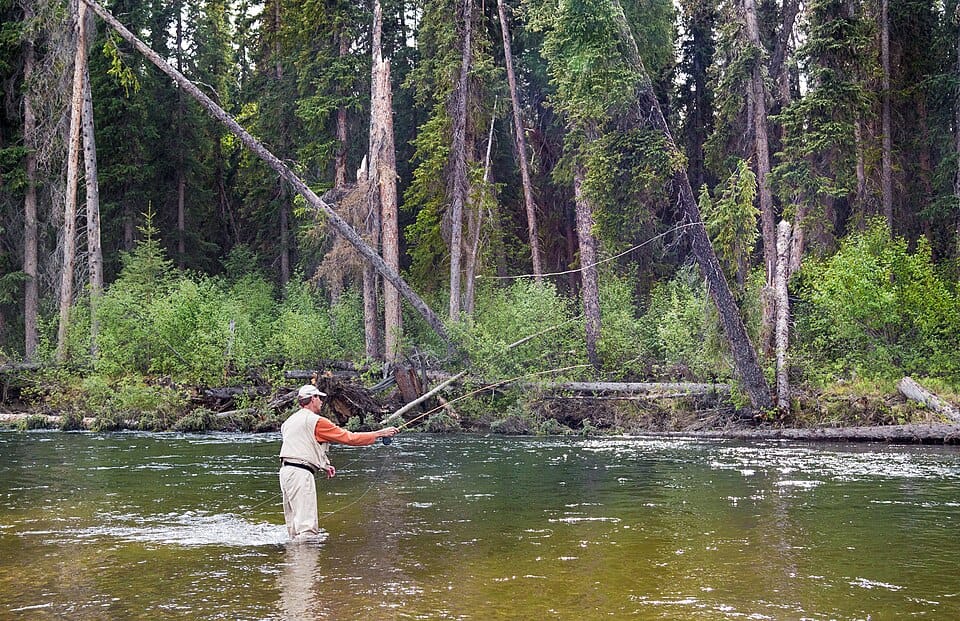
Trout get the magazine covers. Saltwater gets the fly-fishing budgets. Smallmouth bass — the most willing, hardest-fighting, most aesthetically interesting freshwater gamefish in North America once you do the research — quietly carries on its 200-year run as the underrated star of American river angling. May is when the season gets serious. The water finally clears, the fish move out of winter holding lies, and a well-tied streamer in front of a 17-inch smallie produces some of the best fly-fishing of the year for any angler willing to do the work.
If you have spent the last several seasons chasing trout, the move into spring smallmouth is genuinely worth the calendar shift. The fish are stronger pound-for-pound than trout. The fight from a 3-pound smallmouth in moving water exceeds anything a 3-pound rainbow can produce. The takes — particularly on topwater in late May — are visual, violent and entirely unforgettable. And the rivers are typically less crowded than the marquee trout streams within driving distance.
Where to fish in May 2026
The classic spring smallmouth rivers in the United States, in rough order of consistent quality:
The Susquehanna River, Pennsylvania. The country's most famous smallmouth river, with a recovered population now producing trophy-class fish at densities seen in the 1990s. The mid-section between Harrisburg and Sunbury is the prime ground in May. The Smallmouth Catch and Release Initiative has held since 2024 with no signs of relaxing, which has driven trophy fish numbers up sharply.
The Potomac River, Maryland and Virginia. The 70-mile section between Hancock and Great Falls produces consistent May fishing. The Brunswick to Whites Ferry stretch is particularly productive, with public boat ramps every 8–12 miles. The Potomac smallmouth average size has improved significantly since the 2018 invasive northern snakehead population began stabilising.
The James River, Virginia. The middle James between Lynchburg and Richmond is widely considered the most consistent producer of trophy smallmouth east of the Mississippi. May fishing centres on the deeper pools below ledge structures and the eddy lines downstream of mid-river boulders.
The Saint Croix River, Wisconsin and Minnesota. A gin-clear, scenic, lightly pressured river with strong post-spawn smallmouth fishing in late May. Float trips between Stillwater and Hudson are the standard approach.
The Snake River below Hells Canyon, Idaho. The Northwest's most underrated smallmouth fishery, with consistent late-May fishing as the river's water temperature climbs through the optimal 60–68°F range.
The water temperature trigger
Smallmouth bass spring fishing operates on a temperature-dependent schedule. The fish move from deep wintering pools into shallower pre-spawn staging areas when water temperatures climb through 50°F. They begin actual spawning behaviour at 58–62°F and aggressively feed in the post-spawn recovery period at 65–70°F. The May calendar in mid-Atlantic rivers typically catches the late pre-spawn through early post-spawn window, which is when topwater fishing first becomes realistic.
The single piece of equipment that separates consistent anglers from inconsistent ones in spring smallmouth fishing is a thermometer. Knowing the water temperature within 2°F at the time of arrival on the river dictates which water type to fish, which depth to target, and which pattern to fish. Anglers who skip this step routinely spend the first hour fishing structure that the fish have already moved off of.
The patterns that produce
The May smallmouth fly box should contain four pattern categories.
Crayfish patterns. The single highest-producing fly type for spring smallmouth across most of the U.S. The Clouser Crayfish, the Murray's Crayfish, and the Whitlock NearNuff Crayfish are the production-tied options that genuinely outperform fancier custom patterns. Sizes 4 and 6 in olive, brown and rust cover most water. Fish them dead-drift through pools with a slight twitch on the swing.
Streamers. A simple Clouser Minnow in chartreuse-and-white, sizes 2 to 4, works on every smallmouth river in the country. The variations that matter are tying the eyes heavier (3/24 oz lead eyes for deeper water, 1/30 for shallow) and varying the wing length to match local baitfish profiles. The Murdich Minnow in white or shad colours is the second-line streamer for clear-water rivers.
Topwater. The Boogle Bug popper in size 4 olive and chartreuse colour is the producer of the most spectacular spring smallmouth fishing — typically late afternoon into early evening as water temperatures hit their daily peak. Topwater becomes consistently effective once water temperatures cross 65°F, which in northern rivers usually means the back half of May.
Damsel and dragonfly nymphs. Underused by most fly anglers and consistently productive in slower water. A size 8 olive damselfly nymph fished on a slow strip retrieve through eddy water produces fish that ignore more aggressive presentations.
Reading the water
The single skill that separates experienced smallmouth anglers from beginners is reading the water — knowing where in a 200-yard run a fish will actually be holding versus where the fish appear to be holding. Spring smallmouth concentrate in three structural categories that experienced anglers identify in seconds and beginners often miss entirely.
The first is the foam line at the back of riffles. Where two current threads converge below a riffle and create a subtle foam line, smallmouth pre-spawn fish will hold in the slower water immediately adjacent to the foam, intercepting whatever drifts down the seam. Fishing the foam line with a crayfish or streamer dead-drifted into the seam produces consistently.
The second is the eddy behind boulders. Mid-river boulders in 3 to 6 feet of water create downstream eddies where smallmouth hold and feed. The cast that works is upstream and across, allowing the fly to drift past the boulder and into the eddy. Anglers who cast directly to the boulder typically miss the fish, which is holding in the slower water 4 to 8 feet downstream of the obstruction.
The third is the flat below ledge drops. River sections where bedrock ledges create a sudden depth change from 2 feet to 6 feet are smallmouth magnets in spring. The fish hold in the deeper water immediately below the drop and feed upward. The cast presentation is across the drop with the fly sinking into the deeper water, then stripped or drifted up the face of the ledge.
The gear baseline
The right rod for spring smallmouth on a medium-sized river is a 6-weight, 9-foot fly rod. A 5-weight will work in light wind and clear water but lacks the backbone to throw heavy crayfish patterns or to fight a 4-pound smallmouth in current. A 7-weight is overkill for most river situations but is the right choice for windy days, larger streamers, or larger rivers like the Susquehanna in flood-affected conditions.
The reel should hold 100 yards of backing — smallmouth in current can run further than trout anglers expect. A standard floating line with a 9-foot, 1X to 0X tapered leader handles 90% of spring smallmouth situations. A sink-tip line is worth carrying for deeper pools but is less essential than trout anglers tend to expect.
A wading staff is more useful in smallmouth rivers than in trout streams. The bedrock and ledge structure that smallmouth love produces wading conditions that are slipperier and more uneven than gravel-bottomed trout water. Felt-soled boots are illegal in some river systems for invasive species control reasons, so check local regulations and rubber-soled options first.
The catch-and-release ethic
The recovery of smallmouth bass populations in major American rivers over the past fifteen years is, in significant part, a story of the catch-and-release fly-fishing community taking up the conservation cause. The fish recover slowly relative to their growth potential — a trophy 21-inch smallmouth in the Susquehanna may be 14 to 16 years old. Returning these fish to the water, particularly the larger pre-spawn females in May, has direct measurable consequences for the next decade of fishing on the river.
Most experienced spring smallmouth anglers in 2026 fish exclusively catch-and-release on rivers where it is not formally required. The practice has become culturally embedded enough that you will be quietly judged at the boat ramp for keeping fish on a Pennsylvania or Virginia trophy river. The judgment is, in this case, fair.
If May 2026 is the month you finally make the move from trout to smallmouth, or expand your seasonal calendar to include both — the fishery is ready, the rivers are in better shape than they have been in three decades, and the fish are waiting in exactly the structure you would expect them to be holding. The patterns work. The water-reading takes a season to learn. The fight, when it comes, justifies every minute of the move.