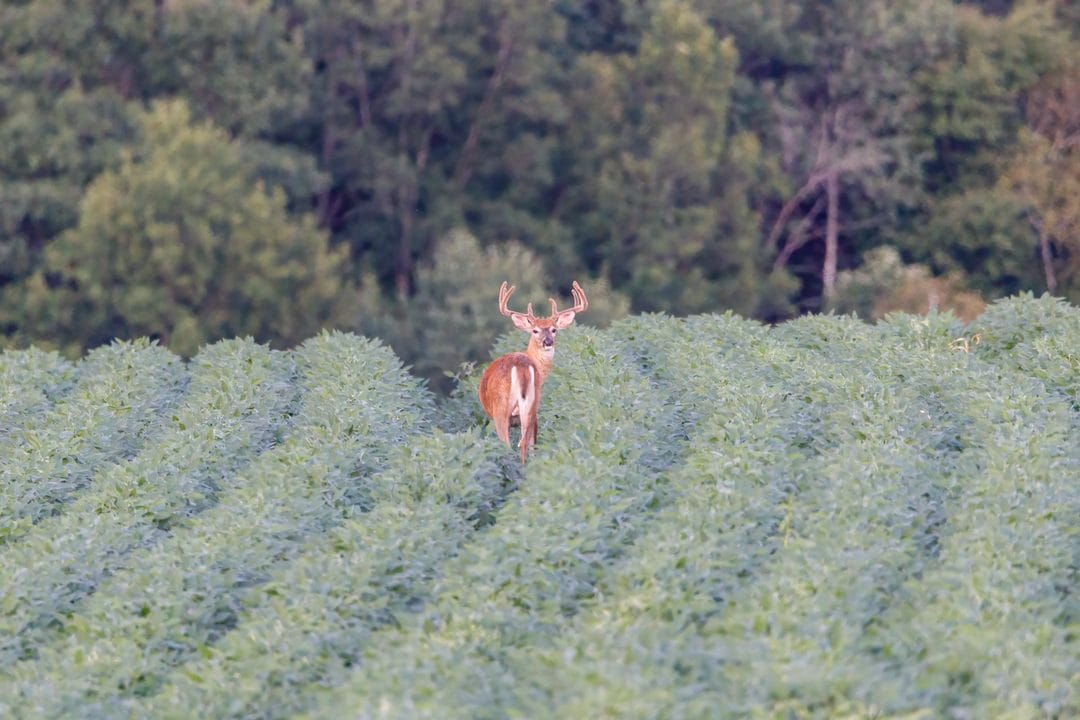
Glass a soybean field in the last hour of July daylight and you'll see deer that don't exist once October rolls around — bachelor groups of two, three, sometimes five bucks feeding in the open, antlers still wrapped in velvet, completely unbothered by anything on two legs. That window closes fast. By the third week of August most of those groups start to break up, and by the time archery season opens across most whitetail states in the first two to three weeks of September, the daylight patterns you watched in July have already shifted underground.
Why Bachelor Groups Give Away More Than They Should
Bucks in velvet aren't hiding from you the way they will in October. Testosterone hasn't kicked in yet, so the aggression and paranoia that make mature deer nocturnal during the rut simply aren't there in July. A buck bedding in the same fencerow for three straight weeks and walking the same trail to the same field edge every evening is handing you information he'll never give up again once the antlers harden and the group splits apart. This is why serious bowhunters treat July and early August as the highest-value scouting window of the entire year — not September, not October, July. Watch a bachelor group long enough and you'll start to notice which buck is the boldest, which trail he actually walks versus the trail deer just wander near, and what time he commits to the field rather than hanging up on the edge. None of that tells you his exact core area once the rut scatters him, but it tells you where to start looking when the season opens.
Scout the Aerial Imagery Before You Ever Load a Camera
Scouting apps like onX Hunt and HuntStand put a property's contour lines, cover type, and prior years' imagery in your pocket before you ever walk a boot into the woods this summer. Study satellite imagery from the past three or four seasons side by side and you'll often spot a subtle change worth checking in person: a clear-cut growing back into thick bedding cover, a new food plot a neighboring landowner planted last spring, or a saddle between two ridges that funnels travel between a bedding area and a field. Mark two or three candidate bedding areas and access routes on the app first, then go confirm them on foot rather than wandering a few hundred acres hoping to stumble onto sign. A subscription to either app runs under $30 a year, which is cheap next to the gas and boot leather burned walking a large block of ground with no plan at all.
The imagery isn't a substitute for boots on the ground, though. Thermal cover that looks perfect on a satellite photo sometimes turns out to be a flooded slough or a neighbor's cattle pasture once you actually walk it, and the only way to know for sure is to go check.
Running Trail Cameras Without Burning Out a Spot
A cellular trail camera earns its keep in July more than in any other month, and if you only budget for one piece of new gear this summer, put the money there instead of another dozen broadheads. Cameras like Moultrie's Edge series or Spypoint's Link Micro run $100 to $180 and pair with a data plan in the $10 to $30 a month range, which sounds like an unnecessary subscription until you're checking a field 40 miles from home and don't want to walk in every four days disturbing the exact deer you're trying to pattern. Reconyx cameras cost more, usually $350 and up, but the trigger speed and battery life pay for themselves over a full season of near-daily use.
This isn't a blanket rule, though. On heavily pressured public ground where half a dozen trucks park at the same access road every weekend, a cellular camera broadcasting your GPS location back to an app is the least of your worries — the real risk is another hunter finding it strapped to a tree and either walking off with it or, worse, hunting the exact pinch point you spent all July identifying.
Camera Placement That Doesn't Spook the Pattern
Hang cameras on the downwind edge of a field, not in the middle of a trail bucks are already using to enter it. Set them chest height, angled slightly down, and check them on a schedule tied to wind direction rather than whenever you happen to have a free afternoon. Skip the temptation to pull a card in person more than once every 10 to 14 days during summer, since every trip in is a trip a mature buck can pattern right back.
- Field edges and funnel points, not the middle of the field itself
- Mock scrapes refreshed lightly with a scent like Tink's 69
- Mineral sites such as Trophy Rock — but only well off any bedding cover, since a buck visiting a mineral lick in daylight is a buck you're about to educate
- Water crossings on well-used trails, which matter more this time of year than most hunters give them credit for
Reading the Food Shift Before It Happens
Whatever a buck is eating in late July won't be what he's eating on opening day, and that shift matters more than most first-time scouts realize. Soybeans are the magnet through most of the Midwest and Southeast right now, green and full of protein, but by late August those same fields start turning yellow and less palatable just as acorns begin dropping in the white oak stands nearby. A buck bedding near a bean field in July may move his entire core area two ridgelines over once the beans dry down and a good white oak flat starts dropping mast, and if you only scouted the bean field, you'll be hunting an empty stand come opening week. Food plots planted with Whitetail Institute's Imperial Clover or BioLogic's Full Draw hold deer through that transition better than ag fields alone, because the plot stays green and palatable right through September instead of drying out with the row crop around it. Check which oaks are dropping early: red oaks drop later and more bitter, white oaks drop earlier and sweeter, and deer will walk past a red oak flat to hit a white oak ridge every single time. Walk the timber in early August, kick through the leaf litter under a few candidate trees, and you'll know within a week which ridge is about to pull deer away from the beans.
Water Becomes the Whole Game in August Heat
In a summer running 95-degree afternoons, a stock pond can matter more than any food source on the property.
Deer need more water in extreme heat, and does with fawns especially will bed close to a reliable source rather than travel far into open country during daylight hours. Farm ponds, creek crossings, and even a stagnant slough become funnel points precisely because the number of viable water sources on most properties is limited to two or three. Camera coverage on a water source in a dry year often produces better daylight footage than camera coverage on food, since deer visit water on a tighter, more predictable schedule than they'll ever visit a single feeding area. If you can only run one camera on the whole property this month, put it on water before you put it on the best-looking trail through the timber.
Scent Control Matters More in July Than October
The instinct every scouting season is to check cameras more often than the deer can stand, and July is exactly when that instinct does the most damage. Rubber boots, scent-free soap, and an ozone unit like an Ozonics generator matter less here than plain discipline about how often you walk into a bedding area. Enter and exit on the same low-impact route every time, preferably one that follows a fence line or a ditch rather than cutting straight through the middle of a field. Glass fields from a truck or a distant rise with a solid pair of binoculars, something like Vortex's Diamondback HD 10x42, instead of walking the field edge to take a quick look, because that quick look is exactly the kind of intrusion that turns a daylight-visible bachelor group nocturnal by the second week of August.
None of this means never walking in. It means treating every entry like it costs something, because on a mature buck's home ground, it does.
What All This Scouting Buys You in September
By the time archery season opens across most of the Midwest and Southeast in the first two to three weeks of September, the bachelor groups you watched all July will have split, the beans will be turning, and the buck you patterned to a fencerow trail at 7:40 every evening may be bedding half a mile further into the timber. That's fine. You already know the ridge he moved to, the oak flat that pulled him there, and the water source he's still hitting on the way there — which is more than the hunter parked next to you at the boat ramp will know when he finally starts scouting the weekend before opening day.