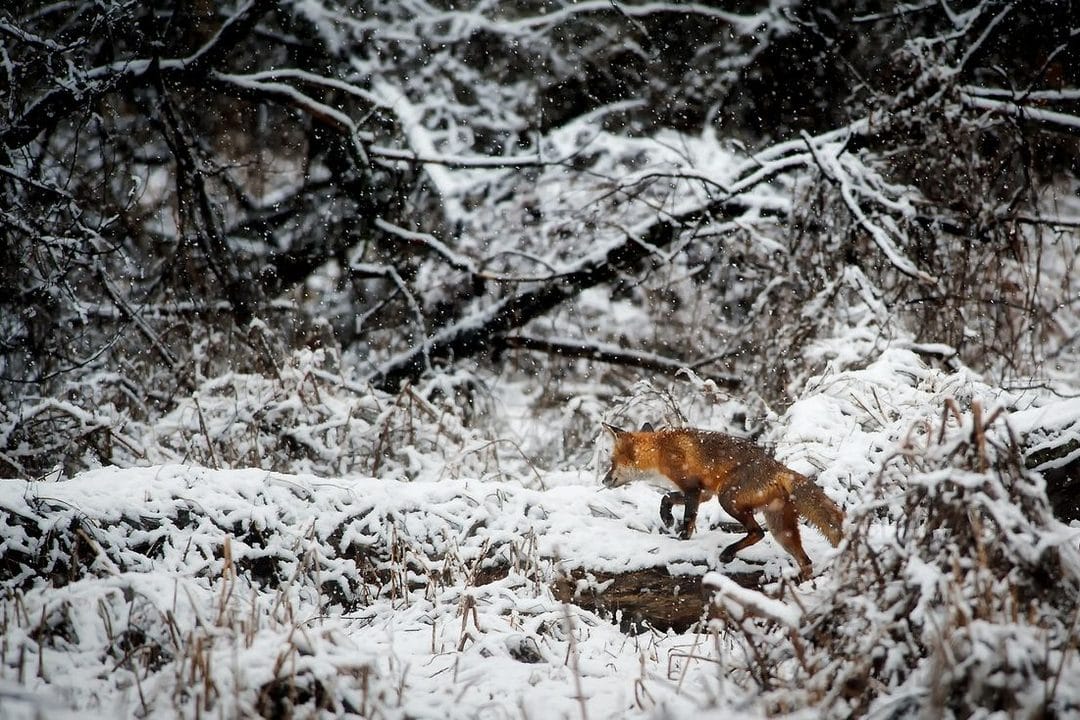
The first time most deer hunters see a canine track frozen in September mud along a fence line, they think coyote and move on. The trapper walking the same fence line sees a set location. That difference in reading the same ground is really the whole hobby: trapping runs on the same scouting instincts you already use for whitetail, just pointed at a species you've spent years trying to keep off your food plots instead of trying to put in your freezer.
Fall is when the interest spikes, and for good reason. Coyote and red fox activity picks up sharply from September through November as young animals disperse from their home territories looking for new ground, which means more animals moving through unfamiliar country and making mistakes. It's also the exact window most state fur seasons open, so the timing lines up almost too well. But foothold trapping is not something you pick up from a YouTube video and a $40 trap off Amazon — the gear, the regulations, and the actual set construction all matter more than beginners expect, and getting any one of the three wrong either catches nothing or gets you a citation.
Why Foothold Traps, Not Snares or Cage Traps
Three tools dominate predator trapping: foothold traps, cable restraints (snares), and cage traps. Cage traps work fine for raccoon and opossum but coyotes almost never enter one — they're too trap-shy around enclosed structures for it to be worth the effort. Cable restraints are effective and cheap, but a growing list of states restrict or ban them entirely for coyote and fox because of non-target catches, and where they're legal the regulations on breakaway locks and loop size get specific fast. That leaves the foothold trap as the standard tool for anyone serious about canines, and it's the one worth learning first regardless of what you add to the line later.
Buy the MB-550 or MB-650 from Minnesota Brand, or a Bridger #2 coilspring — not a bargain-bin no-name trap from a big-box outdoor aisle. The difference isn't marketing. Cheap traps run weak springs, sloppy jaw tolerances, and pan tension that won't hold at the 4-to-5-pound setting most fox and coyote sets need, and a trap that fires on a blowing leaf or springs open under a 30-pound coyote's foot teaches that animal to avoid your entire set line for the rest of the season. That single blown set can cost you a week of scouting on a stretch of ground you'll now have to rest before trying again. The MB-550 in particular has become close to an industry default for coyote work because the jaw spread and spring strength match the species without over-building for something the size of a fox, and most trapper-supply catalogs list it as their baseline canine trap for exactly that reason. Fox trappers who work smaller-jawed traps like the MB-450 report fewer pulled catches on lighter animals, though the smaller jaw spread means more precise pan placement during the set. None of this gear is expensive by hunting standards — a dozen MB-550s runs somewhere around $150-200 — so there's little excuse for starting a line with mismatched or worn-out steel.
Get the Regulations Right Before You Buy Anything
Every state treats trapping differently, and the rules genuinely vary enough that assuming your neighboring state's law applies to you will get you in trouble. Most states require a separate trapping license on top of a hunting license, and a growing number — Minnesota, Wisconsin, and Montana among them — mandate a trapper education course before you can buy your first tag. Trap check intervals are the detail beginners miss most often: some states require checking every 24 hours, others allow 48 or even 72, and it's set per species in a few places, so a coyote set and a muskrat set on the same trapline can legally run on different schedules.
- Every trap must carry a visible identification tag with your name and address, or in some states a trapper ID number issued by the wildlife agency — check yours before the season, because inspection is common on public land.
- In some states, offset or padded jaws are mandatory for foothold traps set for canines, intended to reduce injury on non-target catches like domestic dogs.
- Setback distance from public trails and roads is regulated almost everywhere, typically somewhere in the 5-to-15-foot range depending on jurisdiction, and a few counties add their own stacking rules on top of the state minimum.
- Landowner permission has to be in writing in most jurisdictions, not just a handshake, and a fair number of trappers lose access every year over skipping that one step.
- Bait and lure restrictions, non-resident tag surcharges, and disposal rules for carcasses also vary by state, among other details that rarely make it into the beginner guides.
Your state wildlife agency's trapping regulations PDF is not optional reading — it's the actual rulebook, and it changes some years without much fanfare.
The Dirt Hole Set Is Still the Workhorse
Of the dozen or so standard predator sets, the dirt hole is the one worth mastering before anything else, because it mimics a food cache and both coyotes and fox investigate it out of instinct rather than curiosity. You dig a hole angled into the ground at roughly 30 degrees, bed the trap in front of it at the right depth for your soil, add bait or lure deep in the hole, and cover the trap with sifted dirt so no metal or foreign texture shows. Pan tension matters here more than almost anywhere else in the set — set light enough that a coyote's front foot triggers it, heavy enough that a 10-pound raccoon walking past doesn't. Boil your traps in a logwood or walnut-hull dye bath before the season starts, then wax-dip them, because raw steel throws off a shine and a scent that a wary coyote will pick up from several feet away. Bed the trap itself a full quarter-inch below the surrounding dirt so the jaws sit flush once you sift cover material over the pan, and pack a thin dirt backing behind the hole so loose soil doesn't collapse into the trap bed after the first rain. Most experienced trappers also stake with a disposable stake rather than a chain drag near roads or trails, since a dragging coyote covers ground fast and can pull the whole set into cover where it's harder to recover quickly. Get the bedding and the dye job right and the same set location can produce more than once in a season, which is more than you can say for most beginner mistakes on a first-year line.
The flat set and the cubby set round out the basic toolkit, and each one solves a problem the dirt hole doesn't. A flat set works well in open, sparse cover where a dug hole would look out of place against bare ground, while a cubby — a small enclosure built from sticks, rock, or brush with the trap bedded at the entrance — pulls double duty by both directing foot placement and looking like natural shelter debris rather than a human-built structure. Learn all three before you specialize; a set line built entirely around one technique will underperform once the terrain changes.
Lure and Urine: The Smell That Actually Pulls Animals In
Gland lure and urine-based call lures do the real work of drawing an animal to your exact set location from beyond visual or scent-trail range. Carman's, Wildcat, and O'Gorman are three brands with real track records among working trappers, and each one tends to have regional followings depending on what local fur has been conditioned to over the years — ask at your nearest fur buyer or trapper supply shop which brand is actually moving animals in your county, because that answer shifts by state more than most beginners expect.
A common mistake is over-lured sets: a fresh trapper dumps a full teaspoon of gland lure into a dirt hole and wonders why nothing comes near it for a week. Coyotes are naturally wary of overwhelming scent concentrations in open ground, since that's not how a real food cache smells. A pea-sized amount worked deep into the hole, refreshed only every week or two, consistently outperforms a heavy dose reapplied daily.
Checking the Line and Handling a Catch
Run your line at the same time each day if the law allows it — animals settle into a rhythm around human activity almost as fast as deer do, and a predictable check schedule reduces stress on a caught animal while cutting down your own scent disturbance across the rest of the set line. Approach every trap assuming it's occupied, and know your dispatch method before you ever set a single trap, because working it out in the field with a live coyote in front of you is the wrong moment to be improvising.
What a Pelt Is Actually Worth Right Now
Fur prices are nowhere near where they were during the 2012-2013 peak, when a prime coyote pelt could clear $60-80 at auction. Current coyote pelts are running roughly $10-25 depending on region and fur quality, with Western pelts (larger, better-furred animals out of Montana, Wyoming, and the Dakotas) consistently outselling thin Southern coyotes. Red fox isn't much better — expect somewhere around $15-30 for a well-handled Northern pelt sold through a regional fur buyer or one of the auction houses that picked up volume after NAFA wound down.
None of that means trapping isn't worth doing. Most working trappers aren't in it for the pelt check anymore — they're doing it for predator control on their own hunting ground, for the actual skill of reading sign and building a set that fools an animal with a nose built to catch you doing exactly that, and because a coyote pulled off a fawning field in May pays for itself in fawn recruitment long before it pays for itself in fur money. Sell your fur if the price is decent that year. Don't build the hobby around the check.