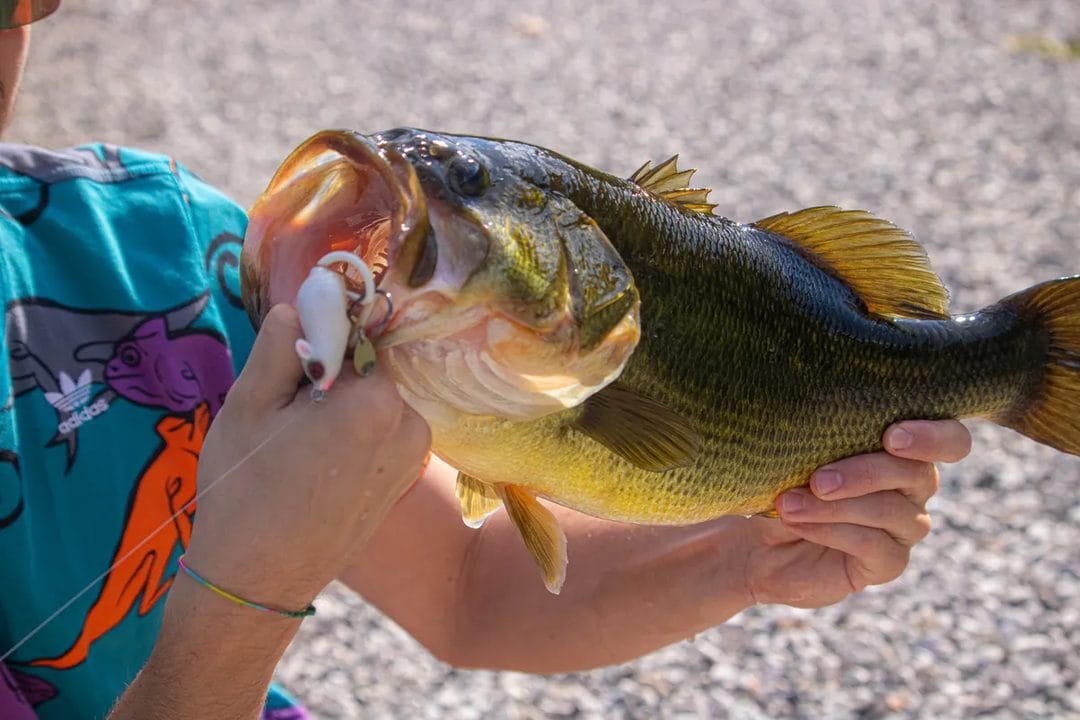
By nine in the morning the bank bite is already dead. The shad have pulled off the shallow flats, the sun is climbing hard over Kentucky Lake, and every boat still working the bushes and laydowns is casting into empty water. Half a mile out, though, a handful of boats are sitting over nothing you can see from the surface — a stretch of open lake that looks identical to the water around it — and they're boating five-pound largemouth every few minutes. That stretch is a ledge, and by late August it holds more quality bass than the entire shoreline combined.
Why Bass Leave the Bank in August
Largemouth bass don't like water above roughly 85°F any more than you'd enjoy a swim in a hot tub set to boil. Shallow flats and coves bake under direct sun through July and August, and dissolved oxygen in that warm water drops fast, especially once the wind lays down for a few days. Deep river-channel ledges — old creek beds and roadbeds now sitting 12 to 25 feet under a reservoir — stay several degrees cooler and hold noticeably more oxygen, and they sit close enough to deep water that bass can slide even deeper the moment a cold front or a bright afternoon pushes them off the structure. Baitfish make the same move for the same reason, and where the shad go, the bass follow within a day or two, not weeks.
This is the pattern that built Kentucky Lake and Lake Guntersville's reputation as summer tournament lakes, and it isn't limited to those two reservoirs. Any TVA impoundment, most Midwestern flood-control lakes, and a good number of Northern natural lakes with old river channels running through them will stack fish on comparable structure once surface temperatures climb into the low 80s. Table Rock, Beaver Lake, Lake Eufaula, Sam Rayburn — the specific names change, but the physics driving the fish out to the ledge doesn't.
Finding a Ledge Worth Fishing
Not every drop-off holds fish, and this is where most weekend anglers waste a full tank of gas. A ledge worth your time needs at least one hard piece of cover or a genuine change in the bottom contour — a stump field, a rock pile, an old roadbed, a sharp inside turn where the old creek channel bends against a flat. Smooth, featureless drop-offs get crossed over by baitfish but rarely hold bass for more than a few hours at a stretch. Run your electronics down the channel at idle speed and mark anything that breaks the pattern of the bottom. A Garmin LiveScope or Humminbird MEGA Live setup makes this almost unfair now — you can watch individual fish sitting on the structure in real time rather than guessing from a 2D sonar return — but a decent side-imaging unit from five years ago will still find the same stump rows if you're patient and willing to idle the same quarter-mile of channel three or four times. Buy the electronics before you buy another rod. That single upgrade will put more fish in your boat over a season than any lure on the market.
Rigging for the Depth, Not the Habit
Shallow-water gear doesn't translate to 15 feet of water, and dragging your bank tackle box out to a ledge is the fastest way to spend a morning marking fish you can't get to bite.
A Carolina rig with a 1-ounce weight and a three-foot leader is still the standard for a reason: it covers water fast, stays in contact with the bottom on a slow drag, and the loud click of the bead against the swivel actually calls fish in from a distance the way a rattling crankbait does up shallow. Pair it with a green pumpkin lizard or a Zoom Ol' Monster worm and you have a bait that's caught more ledge bass over the last thirty years than every new soft-plastic shape combined. A deep-diving crankbait — a Strike King 6XD or a Bandit 300 in true colours like chartreuse-and-black or Tennessee shad — is the better call when fish are actively feeding and schooling on top of the structure rather than holding tight to it, and a heavy structure spoon dropped straight down onto marked fish will out-produce everything else on days when bass are suspended six feet off the bottom and refusing anything moving horizontally.
Skip the finesse gear entirely. A drop-shot with 6-pound fluorocarbon has its place in a clear-water tournament, but on a ledge holding 15 to 20 bass and thick current, it's the wrong tool — you need 15 to 20-pound fluorocarbon or braid-to-fluoro leader just to horse a five-pounder away from the brush before it wraps you.
Boat Position and Current Matter More Than the Bait
Position your boat up-current from the structure and cast down and across it, letting the current sweep your bait naturally through the strike zone the way it would sweep a dying shad. Anchoring directly on top of a ledge — a mistake almost every first-timer makes — spooks the exact fish you came to catch, particularly in water clearer than about four feet of visibility. Set up 30 to 40 yards off and work the spot methodically instead. Current itself is not optional here. On TVA lakes especially, generation schedule dictates the bite more than any lure choice you'll make. Call the Tennessee Valley Authority's generation line or check the lake-specific app before you leave the dock — a ledge that's dead at 9 a.m. with no current running can turn into a feeding frenzy the moment the dam starts pulling water an hour later, because moving water pushes baitfish off the structure and gives bass a reason to leave their holding spot and actually chase something.
The Time Window That Actually Matters
Ledge fishing rewards patience in a way shallow fishing rarely does. You might sit on a productive spot for twenty minutes without a bite, then have five fish in the boat inside ten minutes once the current or the light angle shifts.
Don't abandon a spot you've confirmed holds fish on electronics just because the first fifteen casts came up empty — that's the single most common reason anglers who've found the right structure still go home without a limit.
Where the Pattern Falls Apart
None of this holds on shallow, stained lakes without a defined river-channel system — a lot of small Midwestern reservoirs and most farm ponds simply don't have the depth or the current to set up a true ledge bite, and trying to force the pattern there wastes a morning better spent flipping shallow cover instead. It also weakens noticeably during a stable, sunny stretch with no wind and no generation, when bass on some lakes will suspend in open water over the channel rather than relate tightly to any specific piece of structure, which is exactly when a graph showing fish marks can be deceiving — those arcs might be 40 feet off the bottom structure you're trying to fish, not sitting on it.
Late August is close to peak timing across most of the mid-South and lower Midwest, with the pattern typically holding strong through the first proper cold front in September before fish begin sliding shallower again to chase the fall shad migration. If you've got a weekend free before Labor Day, this is the window — the water's still hot enough to have pushed every quality fish in the lake onto a handful of predictable spots, and most of the summer tournament crowd that would be competing with you for those spots has already started shifting attention toward archery season instead.