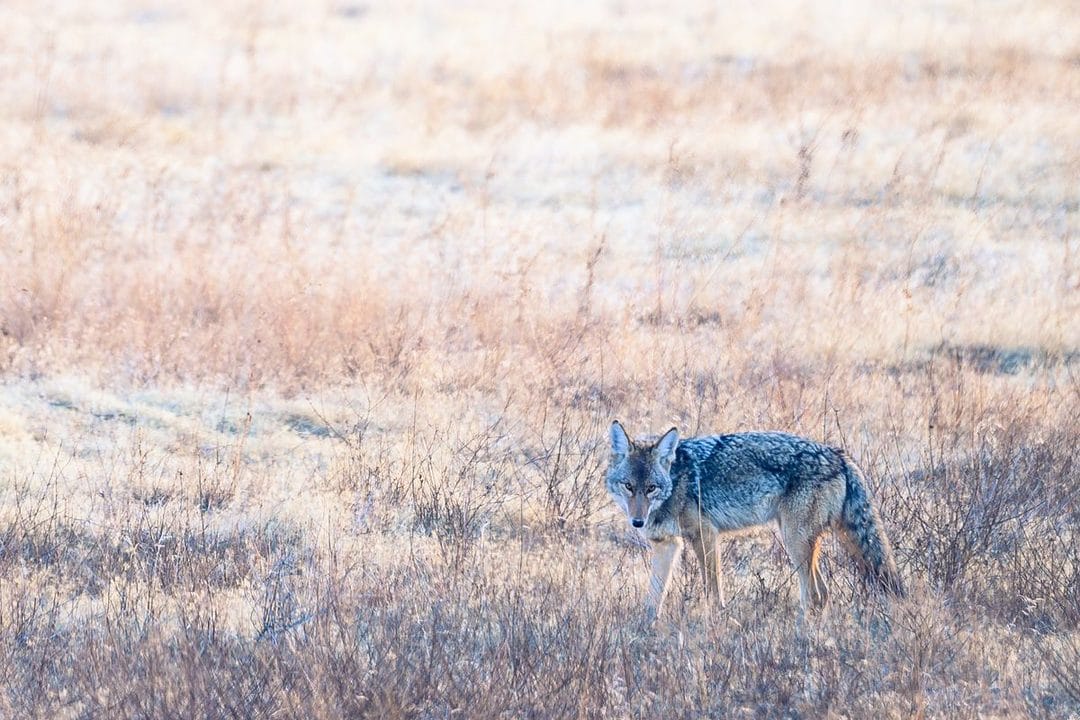
The thermometer drops below sixty for the first time since April, and something changes in coyote behaviour almost overnight. Pups born in spring are half-grown and hungry, family groups start splitting up as juveniles disperse to find their own ground, and the frantic all-night activity of high summer gives way to more predictable dawn-and-dusk movement. Most predator hunters treat this window as a warm-up act before the "real" season in January, when fur is prime and the fields are stripped bare. That's a mistake, and it's one that leaves a lot of coyotes on the table for the hunters willing to get out there in September and October instead.
Why early fall is the window nobody talks about
Fur value is the reason most predator hunters wait until deep winter. A coyote pelt taken in September is nearly worthless to a fur buyer — the guard hairs are thin, the undercoat hasn't filled in, and rub marks from summer heat are still visible on the hide. If you're hunting purely for pelts, winter genuinely is better, and nobody's arguing otherwise. But if you're hunting for population control on a lease, for practice before deer season disrupts your calling stands, or simply because you like the work, fall has real advantages that January doesn't. Coyotes haven't been called at yet this year, so they respond to distress sounds without the hesitation that builds up after a stand gets burned two or three times over a hard winter. Crops are still standing or just coming off in most of the Midwest, which concentrates rodent activity — and coyote hunting — along field edges and fence lines in a way that's easy to read from a truck window.
There's also a practical scheduling argument that gets overlooked. Late August through October is dead time for most hunters — turkey season closed months ago, archery deer season either hasn't opened or is still slow, and duck season is weeks away. A predator hunter who works fall stands hard isn't competing with anyone else for pressure-sensitive ground, and coyotes that haven't heard a howler or a rabbit-in-distress call all year are, frankly, easier to fool than the education-hardened survivors still running around by February.
The pup-dispersal factor
By September, this year's litters are roughly four to six months old and starting to range independently of the adults that raised them. That means more coyotes moving through a given piece of ground during daylight, and more animals responding to territorial howls out of simple curiosity rather than hunger. A juvenile coyote that hasn't yet learned to associate a rabbit squeal with danger will often come in fast and close — sometimes inside twenty yards — in a way a wary adult rarely does after October.
Electronic calls versus a mouth call, and when each one wins
An electronic caller earns its keep in fall for one specific reason: it lets you place the sound source away from your shooting position. A FOXPRO Shockwave or an ICOtec GC500 run thirty to forty yards downwind of the shooter, with the coyote's attention locked on the speaker instead of the person holding the rifle, solves the single biggest problem in predator hunting — animals circling to the downwind side and busting the caller before a shot presents itself. Expect to pay $300–$700 for a remote unit with a reasonable sound library; the cheaper end works fine, and the extra money mostly buys volume, battery life, and decoy-motion attachments rather than better sound quality.
A mouth call — a Primos Freak or a Rich Wykoff-style open-reed — costs under $20 and does something an e-caller can't: it lets you vary volume, cadence, and desperation on the fly in response to how a coyote is actually behaving, rather than cycling through a fixed sound file. The trade-off is that the sound comes from your own position, which matters more in fall than most hunters admit, because juvenile coyotes haven't learned caution yet and will often walk straight at whatever's making noise.
Run both together. Start a stand on a distant howl or lone coyote locator call for two or three minutes, then transition to a distress sound — a jackrabbit or cottontail squeal, run in short bursts rather than one continuous loop — for the bulk of the twelve-to-fifteen-minute stand. Coyotes that hang up at 150–200 yards, scenting for danger before committing, respond better to a wounded-bird chatter or pup-in-distress sound than to another round of rabbit screams; switching sounds mid-stand when an animal stalls out is one of the more reliably effective adjustments a caller can make, and it's the single biggest difference between a stand that produces a coyote and one that doesn't.
Stand selection: read the field, not the map
Coyotes don't read property lines off a plat map, and neither should you.
E-scouting tells you where the cover is, but it won't tell you where a coyote is actually going to be crossing at 6:45 a.m. in early October. Fence lines between standing corn and cut wheat, the low saddle where two drainage ditches meet, and the edge of a CRP field bordering a harvested bean field all concentrate rodent traffic and, by extension, coyote traffic. Set up with the wind quartering into your face or crossing you, never at your back, and pick a position that lets you see 300 yards in the direction you expect an animal to approach from while keeping your own silhouette broken by a fence post, a round bale, or standing brush.
Fifteen minutes per stand is the reasonable floor in fall, when coyotes are moving more and responding faster than they will by midwinter — don't burn thirty minutes sitting on a stand that's dead after the first ten. Move at least half a mile between calling setups; coyotes hear farther than most hunters credit, especially across open stubble fields, and working two stands too close together just educates the second one before you ever get there.
Wind is the whole game
Get this wrong and nothing else matters. Coyotes almost always try to circle downwind of a call before committing to the last hundred yards, which means the animal that never shows might simply have scented you from 250 yards out and slipped off without you ever knowing it was there. Set up so the wind is blowing from the direction you expect the coyote to travel toward your position — not just "a light breeze," but checked with a wind checker or a pinch of milkweed floss at the actual moment you sit down, because field wind shifts direction far more than weather apps suggest on a morning with any topography at all.
Gear that actually matters this time of year
A flat-shooting rifle in .223 Remington or 22-250 Remington handles the vast majority of fall coyote shots, which run 50–200 yards over open stubble and pasture. A 6mm ARC or .243 Winchester earns its keep on the ranch-country stands where shots stretch past 300 yards, though that's the exception rather than the rule in fall calling. Camo pattern matters less than most gear marketing suggests — a coyote's eyesight isn't especially sharp, and movement gives away far more hunters than pattern mismatch does — but earth-tone clothing that breaks up your outline against a fence line or a round bale still beats bright colours where local regulations don't require hunter orange for predator hunting. Skip the thermal optics in September, even though every gear catalogue will try to sell you a set. They're the right tool for the after-dark hog and coyote hunts that dominate December and January, when cold, calm nights carry heat signatures cleanly across a mile of stubble. Daylight fall stands don't need $3,000 of night-vision gear, though, when a decent 10x binocular and a rifle scope zeroed at 200 yards will put more coyotes on the ground for a fraction of the cost. Save the thermal budget for the winter hunts where it actually earns its keep.
Check the regulations before you set up
Most states classify coyotes as unprotected or nuisance species with no closed season and no bag limit — Kansas, Nebraska, and Texas all fall into this category, which is a large part of why fall calling has grown so popular across the Plains states. A handful of states still require a general hunting or furbearer licence even where there's no season restriction, and a few — Colorado among them — regulate the use of electronic calls or require specific permits for night hunting that don't apply to daylight fall stands. Check your state wildlife agency's current furbearer regulations before you set up; the rules genuinely do vary enough between neighbouring states that assuming last year's Kansas trip covers this year's Nebraska one is the kind of mistake that turns into a conversation with a game warden.
None of this requires specialised gear you don't already own if you hunt deer or upland birds. What it requires is showing up during a window most predator hunters skip, reading wind and field edges the way you would for any other stand-based hunting, and being willing to move on quickly when a stand goes quiet. The coyotes are there in September just as much as they are in January — they're simply easier to fool, and a lot less crowded out by other hunters, if you get out before the frost really sets in.