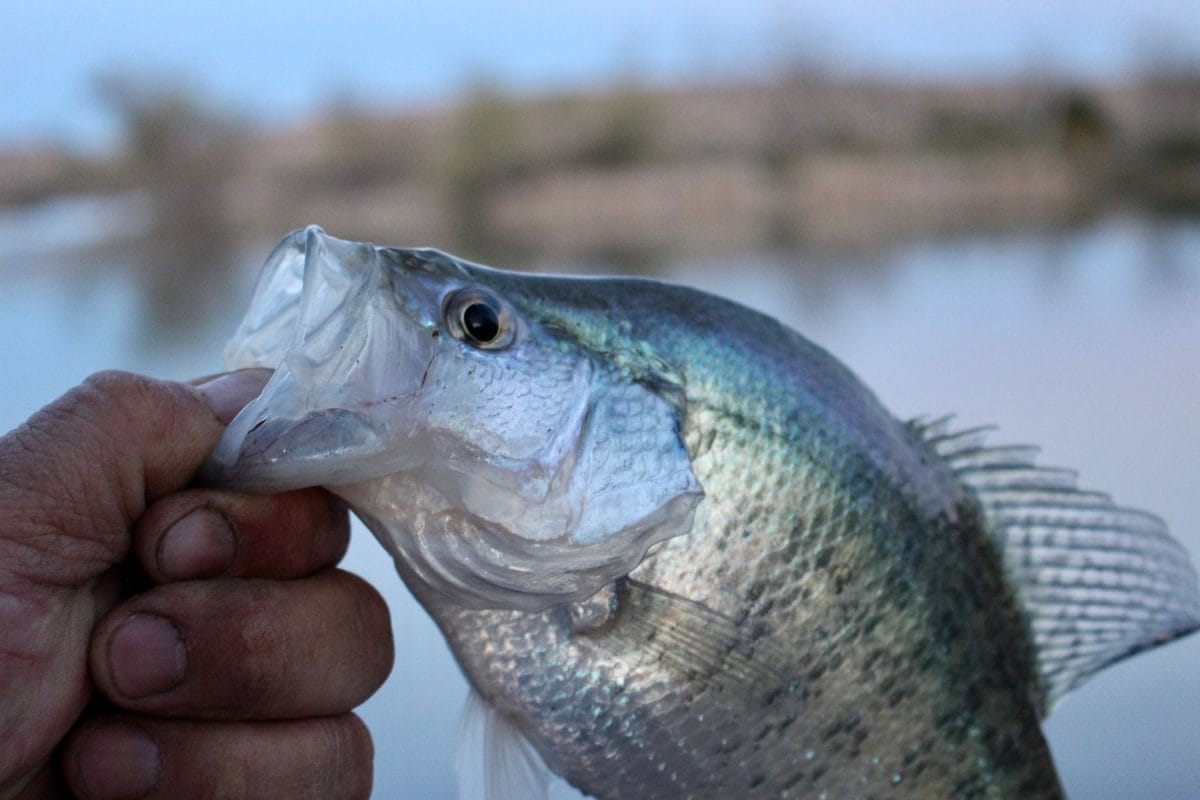
The Worst Time to Stop Fishing for Crappie Is Right Now
Most crappie anglers have a mental map that goes: cold water in spring, fish shallow on beds, catch a pile. Then the water warms past 68°F, the spawn breaks, the fish disappear from the visible structure they were holding on two weeks ago, and the rods go back in the truck. What those anglers are missing is a transition that, on the right body of water, produces some of the year's best numbers — it just requires moving off the bank and thinking in three dimensions instead of two.
Post-spawn crappie don't disappear. They suspend. The fish that were stacked in 4–6 feet of water over gravel and root structure through May slide out to the first significant depth change they can find — a creek channel edge, a submerged road embankment, the outside bend where a flat drops into 12 feet — and they hold there while they recover from the spawn and reorient to summer feeding behavior. The water temperature they're chasing is the thermocline, specifically the band just above where dissolved oxygen starts to drop, which in most Midwest and Southern reservoirs in June runs somewhere between 10 and 18 feet depending on the lake's depth profile and how much wind mixing it's been getting.
Finding the Transition Depth on an Unfamiliar Lake
A quality fishfinder matters here more than almost anywhere else in freshwater fishing. You're not looking for a hard bottom reading — you're looking for suspended arcs in open water, sometimes over 20 feet of nothing, hovering in a narrow depth band. The Humminbird Helix 7 CHIRP GPS G4 ($449) is the entry point worth owning for this kind of work: the CHIRP sonar separates individual fish from clusters clearly enough to distinguish a crappie school from a baitfish ball, and the side imaging on the higher G4N variant ($549) lets you scan 40 feet to each side of the boat without moving. Garmin's Striker Vivid 7sv ($379) is a solid alternative at a lower price point if you already run a Garmin ecosystem, though the screen washes out faster in direct afternoon sun than the Humminbird.
Once you're on the water, run the creek channels first. On most impoundments built before 1980, the old creek bed is still the deepest structure in a given cove, and that channel edge is the highway crappie use to move between their summer holding depth and shallow feeding forays at first and last light. Mark any suspended arcs you find and note the depth — if you see fish at 12 feet on three separate channel edges in the same cove, that's your target depth for the day. Don't drop anchor on the first mark. Make three or four passes to establish the pattern before you commit to a spot.
What to Throw at Suspended Fish
The presentation that consistently produces on suspended summer crappie is a slow, nearly stationary vertical presentation — and the two rigs that do that best are a small jig under a slip float and a live minnow on a split-shot rig set to the precise depth the fish are holding.
For jigs, the Bobby Garland Baby Shad in the 2-inch version on a 1/16 oz head is the benchmark — it's been in tackle boxes for a reason, and the chartreuse-and-white and "glacier" color combinations are worth having in June when the water has some clarity. At $3.49–$4.99 for a bag of ten, you can stock three or four colors without breaking anything. Tie it on 6-lb fluorocarbon — Seaguar Invizx in 6-lb runs about $16 for a 200-yard spool — and set a slip float 18 inches above your target depth. When the float goes, set the hook with a short firm lift rather than a bass-hook swing; crappie have paper-thin mouths and a hard set pulls through more often than it sticks.
The live minnow approach takes more work but is the better call on days when the fish are lethargic and refusing artificials — which happens more than jig fishermen want to admit. A 1.5–2 inch golden shiner or fat-head minnow hooked lightly through the back on a size 2 Aberdeen hook with a single small split shot runs at the depth you need and moves just enough to draw strikes from fish that are full from a night's feeding and not interested in chasing anything. Your bait shop's live bait quality matters here; fish that arrived three days ago in a crowded bait tank and have been gasping at the surface aren't going to move crappie the way a lively shiner will.
The Light Window You're Probably Missing
Summer crappie do their best feeding at the edges of the light window — the 45 minutes before full sunrise and the hour after the sun drops below the tree line. Not dawn-to-dusk good; edge-of-light good, in a way that most weekend anglers who launch at 7:30 a.m. and pull out at noon completely miss. Set the alarm for 5:00 a.m. and be on the water before the bass boats launch. The fish that were holding at 14 feet at noon will push to 6–8 feet in low light, which makes them easier to find on sonar and more aggressive on a moving presentation.
A headlamp and a rigged rod the night before will save you 20 minutes of fumbling at the ramp in the dark. Black Diamond's Spot 400 ($39) is bright enough to rig by and has a red-light mode that doesn't blow out your night vision before you launch. Small thing. Adds up over a summer of early starts.
The One Piece of Gear Most Crappie Anglers Skip
A quality aerator for your livewell, or a battery-powered bait bucket aerator if you're in a jon boat or kayak. Dead minnows catch far fewer crappie than live ones, and most portable aerators that came stock with budget boats can't keep a full load of shiners alive past the third hour of a summer morning when the water in the well is already 72°F. Marine Metal's Bubble Box ($18) runs on a single D-cell and keeps a half-dozen minnows alive in a 5-gallon bucket. It's not glamorous. Neither is driving home with an empty livewell because your bait died at 8 a.m.