Honker Geese in the Cornfield: Layout Blinds and Realistic Expectations
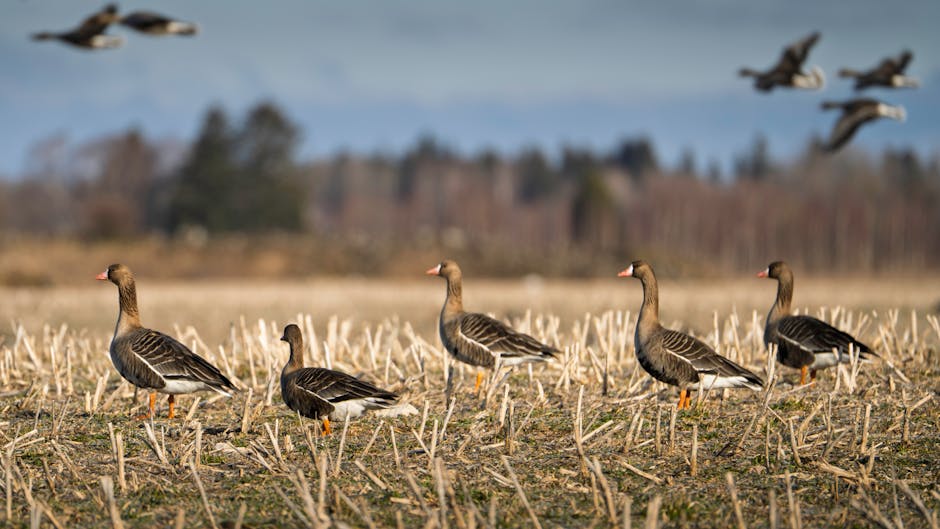
Goose hunting in a cut cornfield is deceptively difficult. The hunt looks simple — put out decoys, lie in a blind, shoot the geese when they land. In practice, geese are the wariest, smartest, and most frustrating waterfowl on the continent. They'll circle a field 14 times, commit, flare at the last second because your blind has a shadow, and fly off to land 400 yards away in an adjacent field.
Finding the Birds
Canada geese roost on open water and feed in agricultural fields — corn, soybeans, winter wheat. The hunt happens where the geese feed, not where they roost. Scouting a goose field means finding:
- Fresh green droppings (within 24 hours) — lots of them, in concentrated areas
- Feathers and down in the field
- Tracks in soft ground or snow
- The "X" — the exact spot in the field where the majority of birds are landing
Scouting means driving ag roads at first and last light to glass birds. When you find 60 to 500 geese working a field, you've found tomorrow's hunt. Permission from the landowner is the next step and sometimes the hard part.
Permission and Pressure
Most goose hunting in the Midwest happens on private land. Farmers field-hunt their own or lease to outfitters. Knocking on doors still works, especially if:
- You offer to close gates, pick up trash, and respect the ground
- You commit to not bringing a dozen people
- You're happy to leave after one morning hunt so the field rests
A goose field hunted twice in a row stops producing. Rest your spots; rotate between multiple fields.
The Layout Blind
Layout blinds are coffin-shaped low-profile blinds you lie flat in. They conceal you against the corn stubble, frozen ground, or snow cover. Quality layouts run $350 to $800.
- Tanglefree Radar Rocker — $550, well-built and lightweight
- Final Approach Eliminator — $400 to $600
- Avery/Banded A-Frame or layout blinds — $300 to $700
- Rogers Flambeau — the budget option at $250
Concealment: The Thing That Actually Matters
The blind out of the bag is too shiny, too symmetrical, too obvious. Geese will spot it at 300 yards. You have to:
- Stubble it up — stuff cut corn stalks into the loops and pockets until the blind disappears into the field
- Flag the lid until you shoot — any human-shaped outline gets noticed
- Keep the lid mostly closed until birds commit
- Dig the blind into the ground if the field is loose enough
First-year hunters often skip the stubbling work and wonder why birds flare 80 yards out. Geese see outlines and shadows that don't fit.
Decoy Spread
A goose spread needs to look like feeding birds in formation. 3 to 8 dozen full-body decoys is a typical Midwest spread for Canadas.
- Avian-X AXP or AXF Canada decoys — $280 to $400 per half dozen. Best in the business for realism.
- Dive Bomb Industries (DBI) silhouettes — $120 to $200 per dozen. Lighter, good value.
- Greenhead Gear Pro-Grade — $200 to $300 per half dozen.
- Sillosocks fabric-on-frame decoys — $100 to $150 per dozen. Good for large spreads on a budget.
Formation
Geese feed in family groups spread across a field. A spread should have:
- A landing hole of 15 to 25 yards, just past your blind, downwind
- Decoys facing into the wind mostly
- Some decoys in feeder poses (head down), some in rester poses (head back on body), some active (upright alert)
- Natural-looking gaps and family groupings, not a solid carpet of decoys
A pod of 6 decoys here, 10 there, 15 over there reads more natural than 40 bunched together. Real geese don't stand shoulder-to-shoulder.
Calling
A goose caller works birds with honks, clucks, moans, and murmurs. Too loud too often flares birds; too quiet lets them drift. The dance of calling a wary flock of geese takes years to master.
Popular calls:
- Zink Money Maker — $165. The tournament-style short-reed.
- Tim Grounds Half Breed — $195.
- Sean Mann Eastern Shoreman — $210.
Goose calls take longer to learn than duck calls. Start with practice tapes and YouTube lessons for six months before you try to work birds in the field.
Shotguns and Loads
Same guns as duck hunting work for geese. The shells change:
- 3-inch or 3.5-inch magnum shells
- Steel BB or BBB, or bismuth in larger sizes
- Federal Black Cloud, Hevi-Shot, Kent Fasteel, or Boss Bismuth
Geese absorb shot. You want larger pellets and heavier payloads than you'd use on ducks.
The Honest Day
A good goose hunt brings four to eight birds to the spread in multiple groups, with birds actually committing versus just circling. Many days, you'll have flocks that circle eight times and leave without a shot. Some days, nothing commits.
The limit varies by state but is typically 2 to 5 Canadas per day in most Atlantic and Mississippi Flyway states, higher during early September "resident goose" seasons (5 to 15 per day).
Goose hunting is one of the hunts where outfitters earn their money. A good outfitter with scouted fields, quality decoys, and calling experience will kill birds in conditions where a beginner will sit and watch flocks go elsewhere. DIY takes years.
The Part You Don't Read About
Goose hunting in January on a cornfield in Iowa at 10°F is miserable. Your fingers don't work. The coffee's cold by 8 a.m. The birds might not even fly. You'll ask yourself why you're doing this three times before first light.
Then a flock of 40 Canadas locks up on your spread at 90 yards, drops its landing gear, and swings into the hole. The next two minutes are the reason.