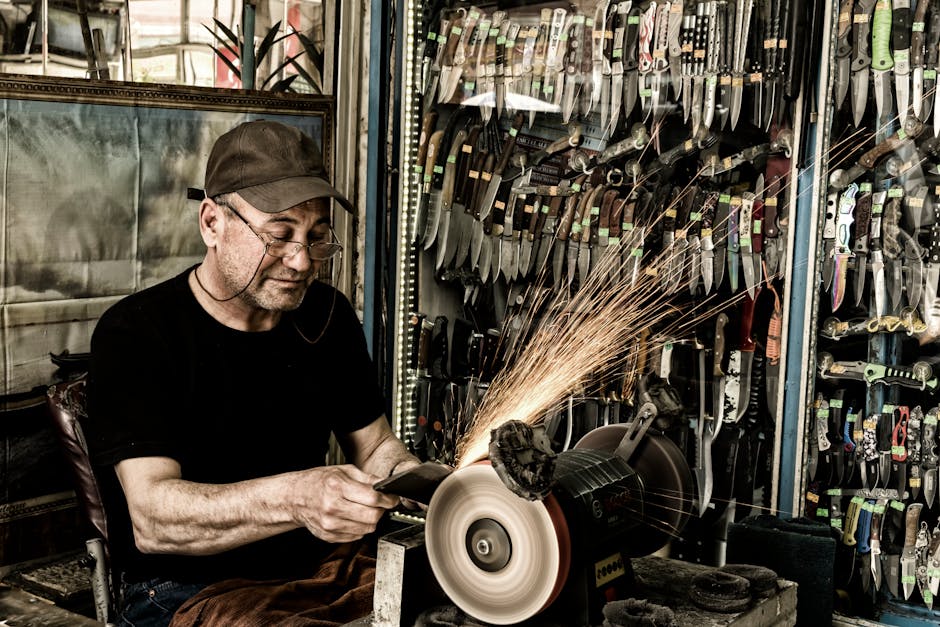
On the second day of an elk hunt in southwest Colorado three seasons ago, I cut my Benchmade Bugout's edge down to nothing breaking down a cow elk. Four hours of boning meat off bone, hitting sinew, working through cartilage, and the fine clip-point edge that had started the trip shaving hair was now struggling to cut tender meat. I had packed a small field sharpener, a Work Sharp Guided Field Sharpener, in the pocket of my kill kit. Twenty minutes of careful work at camp that night, and the blade was back to shaving. The hunt continued. Without that sharpener, I would have been reduced to sawing with a dull knife for the remainder of the trip, which is miserable.
Most field sharpeners do not actually restore a working edge. They scrape metal off, they polish, they make the blade feel a little sharper for a few minutes, but they do not fix a knife that has been genuinely used hard. After years of trying different systems, I have narrowed my field-sharpening rig to three tools that actually do the job, and I will explain what they are, why they work, and which one matches which hunter.
The Problem with Most Field Sharpeners
The tiny ceramic rod on a keychain is worthless. The small V-shaped pull-through in your glove box is actively damaging to quality knives. The little diamond plates that come in combo packs are okay for touching up but cannot re-establish an edge. These are the three most common field sharpeners most hunters carry, and none of them will rescue a knife that has been used to break down an elk.
Here is the problem. Real sharpening removes metal. It reshapes the edge bevel, removes the rolled or chipped portion of the cutting edge, and creates a new crisp geometry. To do this, you need three things: enough abrasive to actually cut steel at a meaningful rate, a way to hold a consistent angle, and enough size to make stable, repeatable strokes. The tiny rods and pull-throughs fail on all three.
The Three That Actually Work
Work Sharp Guided Field Sharpener
The Work Sharp Guided Field Sharpener, about $40, is a roughly 6-inch-long tool with a diamond coarse side, a diamond fine side, a ceramic rod, a ceramic finishing honer, and a leather strop integrated. It is the most complete field sharpening tool you can carry for the money. It weighs about 3 ounces, takes up about the same space as a folding pocket knife, and can fully restore a damaged edge in 15 to 25 minutes of work.
The built-in 25-degree bevel guides are useful for beginners and fine for most hunting knife steels. More experienced sharpeners may find the guides slightly constraining, but they also remove the main source of beginner errors, which is wandering angle. I have restored edges on my Benchmade 15002 Saddle Mountain Skinner, my Buck 110, and my Havalon Piranta loaner blades using this tool, all in the field. It is the one field sharpener I recommend to everyone without reservation.
The one limitation is for extremely worn or chipped edges. If you have truly destroyed an edge, you will need more abrasive than the Work Sharp Guided provides. For that, you go home and use a proper benchtop system.
Spyderco Sharpmaker
The Spyderco Sharpmaker, about $70, is not strictly a field sharpener. It has a base and upright ceramic rods that are about 5 inches long. However, the rods and a small base can be packed into a medium-size pack for longer hunts where you need full sharpening capability without hauling benchtop equipment.
The Sharpmaker uses pre-set 20-degree and 30-degree angles, which cover nearly all hunting knife geometries. Medium-grit ceramic and fine-grit ceramic rods are included. You can add diamond rods separately for more aggressive metal removal. For a truck-camp or base-camp operation where you are not trying to shave ounces off your daypack, the Sharpmaker is better than almost any purely field-carried tool.
For backpack hunting at high altitude, the Sharpmaker is too bulky and heavy. For a drive-in elk camp with a tent and a cook stove and beer in a cooler, the Sharpmaker lives on the folding table and gets the job done.
Fallkniven DC4 Diamond-Ceramic Stone
The Fallkniven DC4, about $35, is a simple two-sided pocket stone. One side is a diamond plate, roughly 25 microns, for coarse metal removal. The other side is a fine ceramic, for finishing. It is about 4 inches long, 1 inch wide, and weighs under 2 ounces. It fits in a shirt pocket.
For experienced sharpeners who are comfortable holding a consistent freehand angle, the DC4 is all the field sharpener you need. It will put a working edge on any steel a hunter is likely to carry. The diamond side removes enough metal to fix rolled edges or minor chips. The ceramic polishes to a genuinely sharp cutting edge. I have used a DC4 to maintain my hunting knives on pack-in trips where every ounce mattered, and I have never come home with a dull knife because of it.
The downside is the learning curve. If you have never sharpened freehand, the DC4 will teach you expensive lessons by grinding away your edge at an inconsistent angle for a while before you develop the muscle memory to hold a steady 20 degrees. For beginners, the Work Sharp Guided is a more forgiving choice.
What I Actually Carry
For day-hunts and weekend trips, I pack the Fallkniven DC4 in the kill kit. It weighs almost nothing, takes up almost no space, and I have enough experience to use it well. For multi-day back-country trips, I pack the Work Sharp Guided because I may loan it to somebody else in camp, and the guides make it usable by a hunter who does not sharpen regularly.
For base camp operations out of a truck, the Spyderco Sharpmaker lives in the truck toolbox and handles serious rehab work if somebody comes back to camp with a chipped or rolled blade.
What to Skip
Pull-through V-sharpeners with tungsten carbide inserts, the little plastic things with crossed steel scrapers, are the worst field sharpeners available. They remove metal too aggressively, at an angle that is usually wrong for hunting knives, and leave a rough burred edge that feels sharp for about 30 seconds before it rolls again. A $5 Chinese import version of this will destroy a $200 Benchmade in six uses. Even the $30 "premium" versions are bad.
Tiny ceramic rod keychain sharpeners are nearly as bad. They are too small to use effectively on hunting blades, they rarely have enough grit differential to remove meaningful metal, and they are generally a waste of money and pocket space. Skip them.
Steel sharpening rods, the kind that come with kitchen knife sets, are not sharpeners. They are honing rods that realign an edge temporarily. A honing rod is useful when an edge starts to roll and needs to be straightened. It does not replace sharpening. If you bring one to the field, know that it is maintenance, not restoration.
Sharpening Is a Skill You Should Practice
The tools matter less than the hand that holds them. A skilled hunter with a $5 diamond card will produce a sharper edge than an unskilled hunter with a $400 electric sharpener. Spend ten minutes a week at the kitchen table sharpening kitchen knives or a spare hunting knife. Watch a video on consistent-angle sharpening. Develop the feel.
The most common beginner mistake is wandering angle. You start at 20 degrees, halfway through the stroke you are at 25, by the end you are at 30. This grinds away metal without sharpening the edge. Fix this by deliberately holding your wrist and arm locked through the full stroke. Use a Sharpie to color the bevel before you start. After two or three strokes, check where the Sharpie is removed. If it is being removed evenly along the entire edge, your angle is correct. If it is being removed only at the shoulder or only at the apex, your angle is off.
Also, do not press hard. Let the abrasive do the work. Hard pressure bends the edge, produces a rolled-over micro-burr that feels sharp but isn't, and wears out the stone faster. Light, consistent pressure, and more strokes, is better than hard, few strokes.
The Kill Kit
My field kill kit contains the DC4, a Havalon Piranta with ten replacement blades, a Benchmade 15002, a bone saw, game bags, a small 550-cord, and a headlamp. The Havalon is my primary meat-processing knife because the replaceable blades are always shaving-sharp. The Benchmade does the rougher work, the skinning, and the neck cutting. The DC4 touches up the Benchmade when it needs it.
A fresh Havalon blade is sharper than anything I can hand-sharpen in the field, and the $15 pack of ten blades covers two elk and two deer worth of meat processing. For pure meat cutting, the Havalon is my first choice and I suggest every serious big-game hunter keeps one in the pack. For everything else, a real hunting knife that can be re-sharpened in the field is essential.
Your knife will go dull. Plan for it. Pack a sharpener that actually works. Your choice comes down to budget, skill level, and how much weight you want to carry, but do not carry a pull-through or a keychain ceramic rod and tell yourself you are prepared. You are not. Those tools will fail you the moment you need them most.