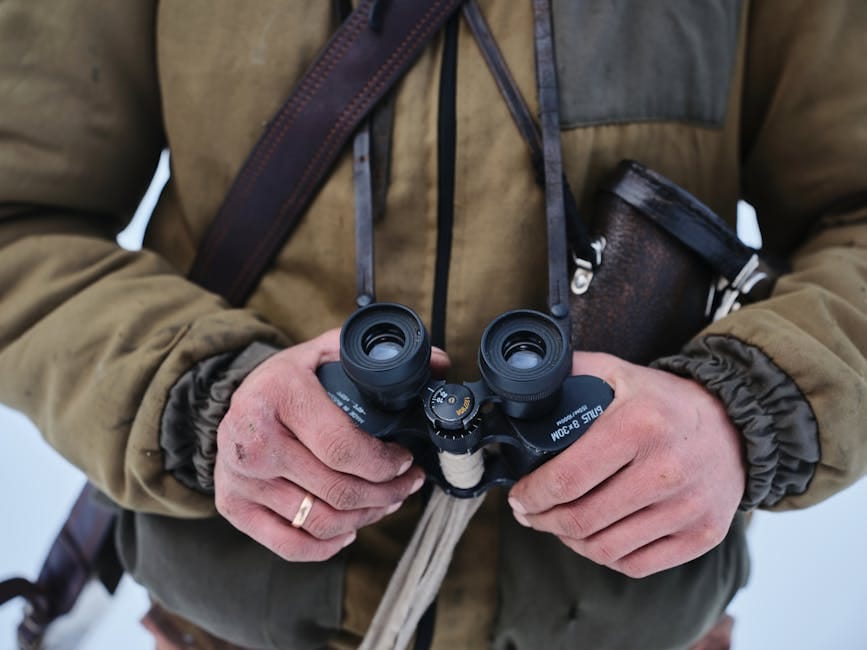
Walk into any sporting goods store and ask for a recommendation on hunting binoculars. The clerk, if he is under 40, will almost certainly steer you to a 10x42. It is the default. It is what Vortex, Leupold, Swarovski, and Zeiss push in their marketing materials. It is what your buddy bought, and what your buddy's buddy told him to buy. It has become so automatic that most hunters never actually think about the magnification question. They walk out with 10-power binoculars the same way they walk out with a black rifle case and a pack of sliced turkey.
I have owned 10x42s. I have owned 8x42s. I have spent weeks in the mountains with both, and after thirty years of hunting whitetail, mule deer, elk, and pronghorn in conditions ranging from dense Appalachian hardwoods to open Wyoming sage flats, I have come to a strong opinion. For 80 percent of hunters in 80 percent of situations, an 8x42 is the better tool. Not a little better. Meaningfully better. And the reason is embarrassingly simple physics that nobody at the counter will explain to you.
The Hand-Hold Stability Problem
Magnification amplifies everything. The image of the deer. The trees around the deer. The motion of your hands. A tiny tremor, a pulse of your heartbeat, a breath going in or out, all of that is multiplied by the magnification of the binocular. Ten-power binoculars show you ten times the shake your hands produce. Eight-power binoculars show you eight times the shake. That difference of 25 percent is enormous in your actual experience looking through them.
Hold a pair of 8x42s to your eyes for thirty seconds on a distant tree line. You will see the tree line. It will be still, or close to it. Now hold a pair of 10x42s at the same distance. The image will be twitching and dancing in a way that simply is not true of the 8-power. Over a long glassing session, 30 or 40 minutes of searching for movement on a ridge, the fatigue from holding 10-power binoculars is real. Your arms shake more, your eyes strain more, you find yourself looking away more often.
Some hunters offset this with a binocular harness, a tree limb, or a tripod adapter. A tripod adapter is the right solution for serious glassing, and if you use one, the magnification argument flips because stability is no longer an issue. But most hunters do not carry a tripod through the woods. They are hand-holding their binoculars, and at that point, 8-power is easier to use.
The Field of View Nobody Mentions
A 10x42 binocular has a narrower field of view than an 8x42. On a typical mid-priced binocular like the Vortex Viper HD, the 10x42 gives you about 319 feet at 1,000 yards. The 8x42 of the same family gives you 409 feet. That is 28 percent more terrain visible at any given time. For scanning, that matters enormously.
Consider what you do with binoculars in the field. Much of the time you are not studying a distant buck at 900 yards. You are scanning a hillside, or a creek bottom, or a pasture edge, looking for movement and shape. A wider field of view means you cover more ground faster. You find the movement sooner. You identify the animal before it disappears into cover. At close-in hunting distances, 100 to 400 yards, the 8-power's wider field is often what makes the difference between seeing the deer and missing it.
In dense timber, this gap is even bigger. A 10-power binocular in thick hardwoods is almost too zoomed in. You are looking at individual leaves on individual branches. An 8-power lets you see the branch, the clearing beyond it, and the deer passing through. This is why European hunters, who do most of their hunting in dense forests, tend toward 7x or 8x binoculars rather than 10x.
The Low-Light Advantage
Exit pupil is the math of how much light reaches your eye through the binocular. It is the objective diameter divided by the magnification. An 8x42 has a 5.25mm exit pupil. A 10x42 has a 4.2mm exit pupil. In low light, when your pupils dilate to 5 or 6mm, the 8x42 is actually sending more usable light to your eye than the 10x42 can.
This is why, at first light and last light, your 10x42 image looks a little grayer and muddier than your 8x42. Your eye is not getting enough light, and the difference of roughly 20 percent more exit pupil makes the 8x42 visibly brighter. Dawn and dusk are when game moves. Your optics need to perform then, not at noon. An 8x42 performs better in those critical minutes.
When 10x42 Actually Wins
I am not saying 10x42 binoculars are bad. They are not. They excel in specific conditions, and those conditions are worth naming honestly.
Open-country glassing at long range, where you are stationary for hours looking for game at 1,000 yards or more, favors 10-power. If you are glassing sagebrush flats for pronghorn or open coulees for mule deer, the additional reach of 10-power helps identify animals sooner. Ideally you are on a tripod in these conditions, which eliminates the hand-hold issue.
Coyote hunting at long range or varmint shooting also favors the 10x42. You are often looking for smaller animals that need more magnification to identify. The additional power earns its keep.
If you glass almost exclusively from a tripod, the hand-hold argument evaporates and you can run as much magnification as you want. For tripod-based western hunters, 10-power or even 12-power binoculars become genuinely useful. But most hunters do not glass from a tripod.
The Binoculars I Actually Carry
My primary binoculars have been a pair of Zeiss Conquest HD 8x42 since 2019. Retail is around $1,100. They are sharp, light, waterproof, and have survived being dropped, soaked, and packed in negative-20-degree weather. Before those I carried a pair of Vortex Viper HD 8x42, about $500, which I still have as my backup pair. They are not as sharp as the Zeiss but they see 90 percent of what the Zeiss sees and cost less than half as much.
I have never once regretted not having 10-power. I have at times wished I had a 15x56 or a spotting scope for specific long-range identification, but that is a different tool entirely, not a replacement for my daily-carry binocular.
When I guide friends who are starting out, I actively steer them toward 8x42 instead of 10x42. Not because 10x42 is bad. Because 8x42 is better for the kind of hunting they are actually going to do, and because they do not know that until somebody tells them. The first time they use an 8x42 for a full morning of glassing, the lightbulb turns on. They come back asking why nobody at the store explained this to them.
Budget Picks
For a first decent binocular in 8x42, you have a clear value ladder. Under $200, the Vortex Diamondback HD 8x42 at around $170 is surprisingly good. Not alpha glass, but fully hunt-capable and warrantied for life. At the $300 to $500 range, the Vortex Viper HD 8x42 at $450 is excellent. In the $600 to $900 range, the Leupold BX-4 Pro Guide HD 8x42 and the Meopta MeoStar B1 Plus 8x42 both punch well above their price. Above $1,000, you are into alpha glass from Zeiss, Swarovski, Leica, and Nikon, and the differences become noticeable but subtle.
Spending $2,500 on a Swarovski EL 8x42 is not crazy if you hunt 40 plus days a year and glass hard. For a casual weekend hunter, it is overkill. A $450 Vortex Viper HD will do everything a weekend hunter needs, and the money is better spent on ammunition, range time, and hunting licenses.
Try Before You Buy
Whatever binocular you are considering, the one thing you must do is put it on your face before handing over money. Hand-hold it for five minutes at the store, focused on the farthest object you can see through the window. Look for eye strain, for edge distortion, for color cast. Some people see better through certain brands than others because eye geometry varies. A pair that is perfect for me may give you a headache, and vice versa.
Then compare an 8x42 and a 10x42 of the same family side by side. The difference will be obvious. You will feel the extra shake in the 10x42. You will see the extra terrain in the 8x42. You will notice the brighter image at dusk through the 8x42. At that point, ignore the gun counter conventional wisdom. Buy what your eyes are telling you, and your eyes will tell you to buy the 8x42.
I have made this recommendation to probably fifty hunters over the last decade. About a third ignored me and bought 10x42 anyway. Of those, half came back within two years and traded for 8x42. The other half probably will eventually. Once you spend a full hunting season behind the right glass, going back feels like working with a tool that was designed for somebody else.