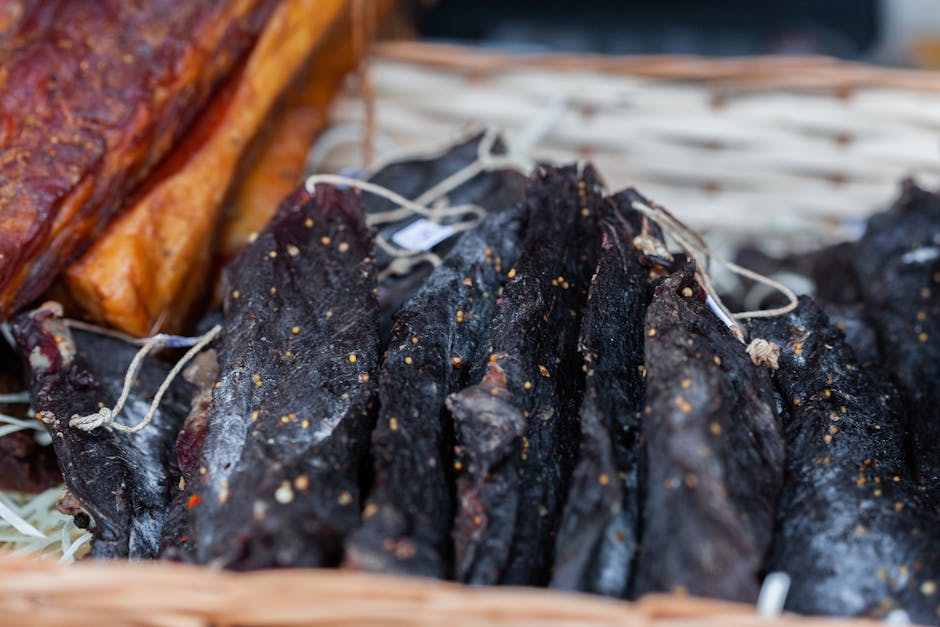
Every November I come back from an elk hunt with somewhere between 150 and 220 pounds of boned-out meat, plus the organs and trimmings if I got lucky. The backstrap and tenderloins become steaks, the shoulders become roasts and braise meat, the hindquarters get broken down into specific cuts, and the miscellaneous lean trim gets divided between burger and jerky. A whole elk will give me 12 to 15 pounds of jerky-ready meat, enough to last my family, my hunting buddies, and the cooler I bring to deer camp for most of a year.
I have made elk jerky every season since 2003. It took me the first four or five years to work out a technique that produced consistently excellent results. Most jerky on the market, even from specialty brands, is not good. It is either too wet, too dry, too sweet, or too salty. It often has a chewy-on-the-outside, brittle-on-the-inside texture that suggests poor moisture management. Home-made jerky done right is better than anything you can buy, and once you know the technique it is not complicated.
Choosing the Right Cuts
The best jerky cuts are large, solid-grained muscle groups with minimal fat and minimal silver skin. Top round, bottom round, and eye of round from the hindquarter are ideal. They are tender enough to eat when thin-sliced and raw-ish, they slice uniformly, and they dry evenly without internal fat pockets turning rancid.
The backstrap makes spectacular jerky but is also a top-tier steak cut. I never make jerky from the backstrap unless the animal had some kind of bullet damage or bruising in the loin area. For purely jerky purposes, the hindquarter rounds are your best source.
Avoid shoulder meat for jerky. The interwoven connective tissue makes the slicing inconsistent, and the finished product is chewy in an unpleasant way. Shoulder belongs in a braise or in burger, not in jerky.
Trimming
Remove every bit of fat, silver skin, and visible connective tissue before slicing. Elk fat, like deer fat, turns rancid during storage of the finished jerky. It also has a waxy, tallowy flavor that ruins the clean taste of lean meat. The time spent carefully trimming is not wasted. Budget about 20 to 30 percent meat loss to trim when processing rounds into jerky-ready meat.
Slicing Technique
Slice across the grain for tender jerky. Slice with the grain for chewy jerky. Most people prefer across-the-grain. I do a mix for variety.
Target slice thickness is 3/16 of an inch, or roughly 5 millimeters. Thinner slices dry too fast and become brittle. Thicker slices take longer to dry and have moisture variations through the thickness. A meat slicer is the best tool. A good chef's knife on partially frozen meat is the next best. A freehand cut on room-temperature meat produces inconsistent slices and inconsistent finished texture.
Put the trimmed muscle in the freezer for 45 to 60 minutes before slicing. The meat should be firm but not frozen solid. A knife glides through cleanly at that temperature and produces uniform slices.
The Marinade That Actually Works
Most jerky marinades are too sweet and too complex. A simple marinade highlights the elk flavor rather than burying it. Here is my standard recipe for 5 pounds of sliced elk.
Combine 1.5 cups of soy sauce, 1/2 cup Worcestershire, 1/4 cup brown sugar, 1/4 cup apple cider vinegar, 2 tablespoons coarse black pepper, 1 tablespoon garlic powder, 1 tablespoon onion powder, 1 tablespoon smoked paprika, 2 teaspoons red pepper flakes, 1 teaspoon pink curing salt, and 1/2 cup water. Whisk thoroughly. Submerge the sliced meat, ensuring every piece is coated. Refrigerate 18 to 24 hours, stirring twice during the time.
The pink curing salt is optional but recommended for long-term storage. It inhibits the growth of Clostridium botulinum, the bacteria that causes botulism. One teaspoon per 5 pounds is within food-safe limits and extends shelf life significantly. Commercial jerky always contains pink salt or sodium nitrite. Home jerky without it is fine if you vacuum-seal and refrigerate or freeze, but for room-temperature storage, use the curing salt.
Variations Worth Trying
For a teriyaki-style jerky, replace the apple cider vinegar with mirin and the brown sugar with honey, and add a tablespoon of grated fresh ginger. For a pepper-heavy jerky, double the coarse black pepper and add a tablespoon of cracked white pepper. For a jerky with a Southwestern profile, replace the Worcestershire with lime juice and add a tablespoon of chipotle powder.
Avoid liquid smoke in marinades. It produces an artificial smoke flavor that does not taste like real smoke. If you want smoke in your jerky, smoke it on a pellet smoker. Do not try to fake it with a bottled additive.
Drying: Dehydrator vs Smoker vs Oven
A proper food dehydrator is the best tool for jerky. An Excalibur 9-tray runs $350 to $400 and will last decades. The even heat and airflow produces consistent jerky. Smaller stackable dehydrators from Nesco work fine for occasional use but the airflow is uneven.
Dehydrate at 160 degrees for 4 to 6 hours, depending on the thickness and the model. The meat is done when it bends without breaking, but does not feel wet. The characteristic "pencil lines" forming at the flex point indicates good moisture level.
A smoker set to 180 to 200 produces excellent jerky with deeper flavor than a dehydrator. 4 to 5 hours at 180 on a pellet smoker using hickory or mesquite pellets produces some of the best jerky I make. This is my preferred method when I have the time and ambition.
A standard oven can produce jerky but is harder to dial in. Set the oven to 170 degrees. Prop the door open with a wooden spoon to allow moisture to escape. Lay the jerky on wire racks over sheet pans. 4 to 6 hours, similar to dehydrator. The results are decent but usually not as even as a dedicated dehydrator.
USDA Food Safety
The USDA recommends heating jerky meat to 160 internal at some point in the process to kill potential pathogens like E. coli. Most dehydrators do not reliably hit 160 at the meat's core during drying. The safest approach is to either pre-heat the meat or post-heat it.
Pre-heating is my preference. After the marinade step but before dehydrating, steam the jerky strips for 5 minutes in a bamboo steamer, or microwave them in two minute bursts until they hit 160 internal. Pat dry. Then dehydrate as normal. This adds one step but ensures safety.
Post-heating is simpler. After the jerky is fully dehydrated, place it in a 275-degree oven for 10 minutes. This brings the interior up to 160+ and also drives off any remaining surface moisture. The jerky firms up slightly and stores longer.
If you use the pink curing salt and vacuum-seal and freeze the finished jerky, the safety concerns are reduced. For jerky stored at room temperature, either pre-heat or post-heat step is highly recommended.
Storage
Finished jerky gets vacuum-sealed in 1/4-pound bags. Each bag holds about one hunting-day's supply of snacks. Bags go in the freezer for long-term storage. A vacuum-sealed bag of jerky in the freezer keeps for a year without quality loss. The same jerky in a Ziploc bag in the freezer is good for 3 to 4 months. The same jerky at room temperature in a pantry, properly cured, is good for 2 to 3 months.
I usually pull one vacuum-sealed bag out of the freezer at a time, keep it in the cupboard, and eat through it over a couple of weeks. Jerky in open storage absorbs humidity and softens over time, so keeping it sealed until needed is the right approach.
The Economics
Commercial jerky runs $25 to $40 per pound. Home-made elk jerky, assuming you shot the elk yourself, costs you the price of spices and dehydrator time. 5 pounds of sliced meat produces about 2 pounds of finished jerky after moisture loss. At zero meat cost and maybe $10 in spices and electricity, you have $70 to $100 worth of jerky. Multiply that by 8 to 10 five-pound batches per elk, and you are looking at $500 to $1,000 of jerky value per animal.
This is one of the quiet economic arguments for hunting that nobody makes. A good elk hunt produces not just meat in the freezer but also a year's supply of premium snacks that would otherwise cost hundreds of dollars. The more of your animal you process yourself, the more value you extract, and the more you save on grocery bills.
What Makes Elk Better Than Beef for Jerky
Commercial jerky is almost always made from beef, which has enough intramuscular fat that the drying process can produce a greasy-feeling finished product after extended storage. Elk, being much leaner, produces jerky with a cleaner finish and longer shelf life. The flavor is milder than deer and richer than beef, which many people find is actually their favorite. I give away bags of elk jerky at deer camp every year and people consistently rank it above commercial beef jerky.
If you are new to wild-game processing and wondering what to do with the bottom round of an elk hindquarter, do not overthink it. Trim, slice, marinate, dehydrate. In about 36 hours of mostly passive work, you have premium jerky in the freezer. It is one of the simplest and most rewarding wild-game preparations.