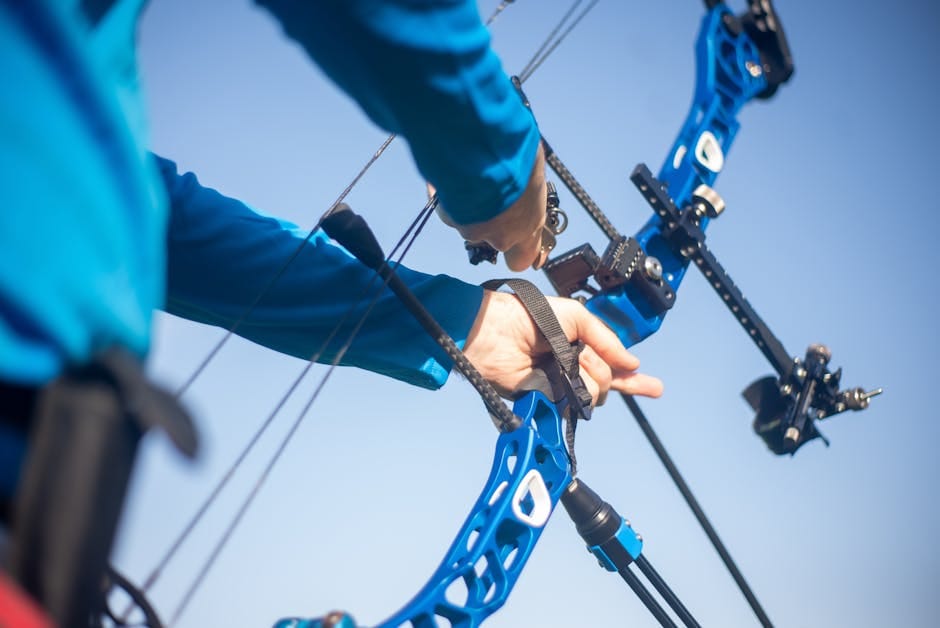
The guy behind the counter at a big-box sporting goods store sold my cousin a compound bow cranked to 70 pounds because that is what was on the showroom floor. At 5 foot 8 and 160 pounds, he could pull it back once, maybe twice, before his shoulder started shaking. He shot three arrows that afternoon, developed target panic the same week, and never touched the bow again. That bow hangs in his garage in Pennsylvania gathering dust, a $900 monument to the myth that more poundage equals more dead deer.
I have been shooting compounds since 1998, and the vast majority of problems I see in the field, at the range, and in customer forums come down to a bad setup. Wrong draw length. Too much poundage. A peep tube that tears off on the first cold morning of season. Nock points half an inch out of true. Most of it was done at the pro shop by a well-meaning kid with six months of experience, and most of the shooter never knew the difference because they have nothing to compare it to.
Draw Length: The Single Most Important Measurement
If you get nothing else right, get draw length right. Every compound bow has a fixed draw length, unlike a traditional bow where you simply pull back to your anchor. Draw a compound too short and your form collapses forward, your anchor point becomes a guess, and the string slaps your forearm on every shot. Draw it too long and you stand locked out with your bow arm, unable to hold steady, fighting the valley of the cam with every breath.
How to Actually Measure It
The old wingspan method, where you measure from fingertip to fingertip and divide by 2.5, is a starting point and nothing more. It gets you within an inch. That inch matters enormously. The real test is shooting. Put on a release aid, come to full draw against the wall of the cam, and check these three things. Is your bow arm slightly bent at the elbow, not locked out? Does the string touch the tip of your nose or corner of your mouth without you craning forward? Are your shoulders relaxed and down, not shrugged up to your ears?
If any of those are off, adjust your draw length. On modern bows from Hoyt, Mathews, PSE, Bowtech, and Elite, this is often a simple module swap or a rotating cam adjustment that takes the pro shop five minutes. Do not let anyone tell you that half an inch does not matter. It does. My personal draw is 28.5 inches, and when I once shot a borrowed bow set to 29, my groups opened up from tennis-ball-sized to paper-plate-sized at thirty yards. Nothing else changed.
Draw Weight: Less Than You Think
Here is the hard truth almost nobody in the pro shop wants to admit: you do not need 70 pounds to kill a whitetail, a mule deer, an elk, or anything short of a cape buffalo. A well-tuned bow at 55 pounds shooting a modern broadhead will pass through both lungs of a 250-pound bull elk from a reasonable broadside angle. I have watched it happen. I have done it myself.
The problem with overbowing yourself is cumulative. You can pull it in July on the back porch. You can pull it in October when you are warm and adrenaline is pumping. Can you pull it slowly, silently, without warning a deer at 15 yards, in thirty-degree weather, with cold muscles, after sitting in a saddle for five hours? That is the question. Too many hunters cannot, and they either draw in the wrong window, spook the animal, or pull so hard they muscle through the shot and the arrow goes wide.
A Reasonable Starting Range
For most adult male hunters of average build, somewhere between 55 and 65 pounds is plenty. Women and smaller-framed shooters do just fine at 45 to 55. If you can hold full draw comfortably for 30 seconds without shaking, you are in the right weight. If you cannot, drop five pounds and re-test. Your broadhead and arrow weight matter a lot more than raw poundage. A 450-grain arrow at 270 feet per second has more killing authority on game than a 350-grain arrow at 300 feet per second, despite being slower.
Most current bows in the $700 to $1,400 range, the Mathews V3X, the Hoyt RX-7, the Bowtech SR350, the PSE Mach 34, all run in the 60 to 70 pound range as standard. They can be backed down 10 pounds or so without losing much. Do not feel bad about dropping from 70 to 60. Drop it. You will shoot better.
Let-Off: The Most Misunderstood Spec
Let-off is the percentage of draw weight that drops off once you hit full draw and fall into the valley of the cam. A 65-pound bow with 80 percent let-off means you are holding only 13 pounds at full draw. That sounds great, and for most hunting applications it is great. But there is a trade-off that nobody bothers to explain.
Higher let-off percentages, 85 percent and up, make the valley shallower and the transition into full draw softer. This is comfortable but forgiving in a way that hides form errors. Lower let-off, 65 to 75 percent, gives you a stiffer back wall, a more defined anchor, and actually improves accuracy for shooters who know what they are doing. Target archers shoot 65 percent let-off almost exclusively for this reason. The bow tells you when you are at full draw in no uncertain terms.
For a hunter, I would argue 75 to 80 percent let-off is the sweet spot. High enough that you can hold steady when a buck walks behind a tree and you need to wait 40 seconds. Low enough that you have a firm back wall to pull into. If your bow came with 85 percent let-off and you are feeling soft at anchor, ask the pro shop about cam modules that give you 75 instead. Most modern flagship bows have that option.
The Setup Order That Matters
If you are taking delivery of a new bow or setting up a used one, follow this sequence. Skip a step and you will be rebuilding later. First, set draw length based on shooting form, not wingspan math. Second, set draw weight to something you can hold for 30 seconds with shaking. Third, install the rest, either a drop-away like the QAD Ultrarest HDX or a containment rest like the Hamskea Hybrid Hunter Pro, and adjust the arrow level to the Berger hole. Fourth, tie in a D-loop and serve a peep sight to your anchor's natural sight line, not to what the setup book says.
Fifth, paper tune the bow. Shoot through a paper frame at 6 feet. A perfect bullet hole means the arrow is flying straight. A horizontal or vertical tear means the rest needs adjustment or the arrow spine is wrong. This step gets skipped constantly and is the single biggest reason hunters blame equipment for poor groups. Sixth, and only after all the above, sight in your pins at 20, 30, 40, and 50 yards.
I watched a friend in Wisconsin fight with a brand-new Hoyt for three months trying to get it to group at 40 yards. It turned out the pro shop had never paper tuned it. The rest was off by 1/16 of an inch horizontally. One adjustment and the groups tightened to the size of a golf ball. He had been blaming the bow, the arrows, his release, and his eyes.
The Arrow Is Half the Bow
A bow setup is only half complete without the right arrow. Spine, the flex rating of the arrow shaft, has to match your draw weight and arrow length, or accuracy suffers badly. Under-spined arrows flex too much on release and flop downrange. Over-spined arrows do not flex enough and fly erratically. Most arrow manufacturers, Easton, Victory, Gold Tip, Black Eagle, have selection charts. Use them. Do not guess.
For a 60-pound bow shooting a 28-inch arrow, you are probably looking at a 340 or 400 spine shaft depending on the specific manufacturer's system. For a 70-pound bow at the same length, closer to a 300 spine. The pro shop should help, but if they do not consult a chart in front of you, ask why. Mixing broadhead weight matters too. A 125-grain broadhead flies differently than a 100-grain, and changing that also changes the spine requirement.
What a Well-Tuned Setup Feels Like
When everything is right, the bow feels quiet and calm. The draw cycle is smooth, not jerky. You fall into the valley at full draw and it feels like the bow wants to stay there. Your back tension does the work, not your bow arm. At the shot, the bow jumps slightly forward in your hand with no side torque or string slap. The arrow hits exactly where your pin was. You notice you are barely trying.
That is what a $1,200 bow is supposed to feel like, and most of them, out of the box from the pro shop, do not. A proper setup takes an hour and cannot be rushed. If your local pro shop is trying to get you out the door in twenty minutes, find a different pro shop. A good one will put a bow through paper, walk you through your form, and hand you a bow that is genuinely ready to hunt with. That is worth driving two hours for.
Before my next bow goes out of the shop, it gets paper tuned, walk-back tuned at 40 yards, and I shoot a fixed-blade broadhead into a 3D target at 30 yards before I call it done. If the fixed blade does not hit where the field point hits, something is still off. Fix it at the bench, not the treestand.